In today’s leadership environment—full of noise, ego, and constant self-promotion—it’s worth asking a simple question: What does authentic leadership really look like? For me, one of the most powerful examples doesn’t come from a boardroom, battlefield, or business school. It comes from St. Joseph.
1. Leadership Is About People — And Formation
As leaders, we often examine frameworks, models, and historical figures to improve the art and science of leading organizations. But at its core, leadership is about one thing: People.
Few figures in history demonstrate people-centered leadership more powerfully than St. Joseph—the foster father of Jesus, spouse of Mary, and protector of the Holy Family.
- He didn’t build a company.
- He didn’t command an army.
- He didn’t give speeches.
Yet he helped shape the most consequential mission in human history.
2. Obedience to Mission — Even When It Disrupts the Plan
Joseph’s leadership starts with a clear mission and commitment to it.
When faced with uncertainty, Mary’s unexpected pregnancy, he chose to trust rather than try to control. When called by God, he responded immediately.
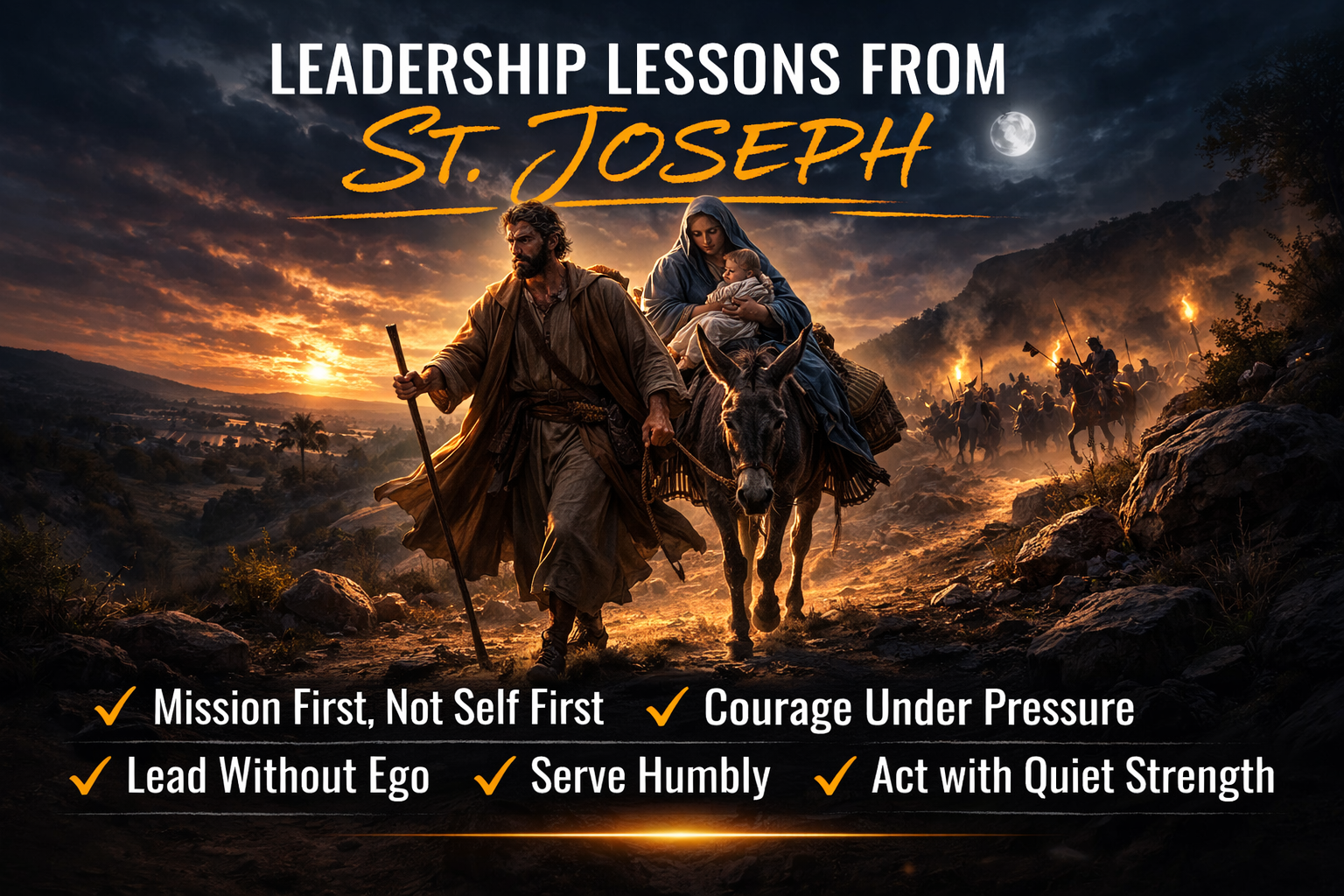
When danger appeared, he responded quickly and fled to Egypt to keep his family safe.
No hesitation. No delay. No need for recognition.
Great leaders don’t just define the mission; they dedicate themselves to it.
3. Courage Under Pressure — Quiet, Decisive Action
Joseph’s courage wasn’t loud or showy.
It was calm, focused, and driven.
- He protected without panic
- Led without domination
- Acted without seeking validation
In today’s world, courage is often confused with visibility.
Joseph reminds us: Real courage is doing the right things, especially when no one is watching.
4. Leading Without Ego — Rejecting the “Ego-Drama”
Joseph never speaks in Scripture. Not once. Yet his actions changed history.
This is the opposite of what many leaders fall into today—what Bishop Robert Barron calls “ego-drama”—where leadership revolves around personal storytelling, recognition, and control.
Joseph lived the “Theo-drama”: A life aligned not to his own script—but to God’s.
- He didn’t need credit.
- He didn’t need visibility.
- He didn’t need applause.
- He needed only to be faithful.
5. Servant Leadership in Its Purest Form
Long before leadership books defined it, Joseph embodied servant leadership:
- Protector – safeguarding his family physically and spiritually
- Provider – faithfully working as a craftsman
- Leader – guiding without control or ego
As Pope St. John Paul II wrote in Redemptoris Custos: “Joseph was a total gift of self.”
That is leadership. Not position. Not title. Not authority. Gift of self.
6. The Power of Quiet Consistency
Joseph’s greatness is found not in dramatic moments—but in daily faithfulness.
- Showing up.
- Providing
- Protecting
- Leading consistently over time.
In modern terms, this is what we might call:
- Operational discipline
- Values-based execution
- Mission-aligned decision-making
But Joseph would simply call it doing what is right—every day.
7. What Leaders Can Take Away Today
In a culture that rewards visibility over virtue, Joseph offers a different path:
- Be mission-first, not self-first
- Act decisively under pressure
- Lead without needing recognition
- Serve those entrusted to you
- Stay grounded in purpose, not ego
This is what it means to be a principled, centered leader.
8. Final Reflection
St. Joseph shows us that leadership is not about being the most visible person in the room.
- It’s about being the most faithful to the mission.
- It’s about protecting what matters.
- Serving without recognition.
- Leading with humility and strength.
In a world chasing comfort and self, Joseph chose duty, sacrifice, and obedience. And in doing so, he became one of the greatest leaders the world has ever known.
9. A Simple Prayer for Leaders
St. Joseph, protector and guide,
Help me lead with humility, courage, and integrity.
Strengthen me to serve others above myself,
And to follow the mission entrusted to me with faith and discipline.
Amen.