Yes, in the words of Sun Tzu, “The supreme art of war is to subdue the enemy without fighting.” — The Art of War
We intuitively understand that large-scale, uncontrolled immigration can become destabilizing when deliberately exploited by hostile actors, criminal networks, or political movements that do not share a nation’s constitutional principles.
Yet President Biden allowed it anyway.
We also know that large-scale immigration from countries not grounded in the philosophies of Western Civilization often struggles to assimilate successfully.
Yet President Biden allowed it anyway.
There are real historical examples in which governments or hostile actors used migration pressure, refugee flows, or demographic destabilization as strategic tools. Scholars and security analysts often refer to this as “weaponized migration” or “coercive engineered migration.”
Recent examples include:
• The Mariel Boatlift — Mariel boatlift involved Cuba intentionally allowing large-scale departures, including some criminals and psychiatric patients. The sudden influx strained Florida’s systems and created political turmoil in the United States. The Carter administration faced major criticism for border control and screening failures.
• Belarus–European Union border crisis — The European Union accused Belarus of deliberately flying migrants from the Middle East to Minsk and directing them toward the borders of Poland, Lithuania, and Latvia in retaliation for EU sanctions. European leaders described it as a form of hybrid warfare designed to pressure and destabilize neighboring states.
• European Migrant Crisis — While largely driven by war and instability in Syria, Iraq, and elsewhere, the crisis produced major political consequences across Europe: the rise of nationalist parties, internal EU conflict, increased terrorism concerns, and growing polarization over national identity and borders. Security services later confirmed that some ISIS operatives exploited refugee routes into Europe.
• Turkey–European Union migrant crisis — Turkey repeatedly used the threat of opening migration flows into Europe as leverage during disputes with the EU over aid, military policy, and political negotiations. European leaders openly acknowledged the strategic pressure involved.
Asymmetric warfare uses unconventional methods to defeat a stronger opponent by exploiting vulnerabilities rather than matching strength head-on. One could reasonably argue that mass immigration involving populations unlikely to assimilate into the host culture can become a form of weaponized migration.
Cultural Divide
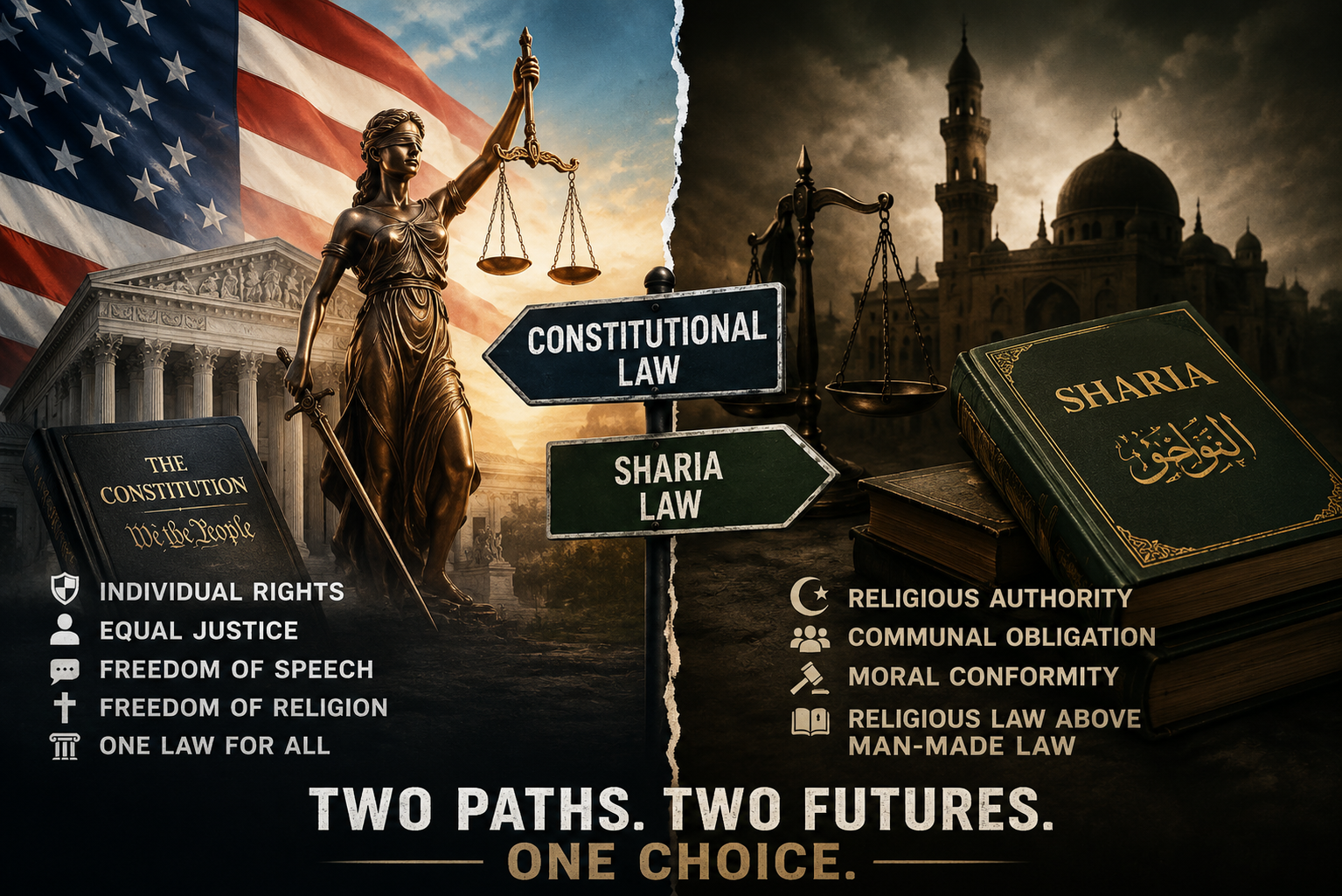
The main conflict between traditional Sharia-based governance and the American constitutional framework centers on differing ideas of legal sovereignty, rather than private religious practices. The U.S. is built on a single constitutional law that applies equally to all citizens, regardless of faith. In contrast, traditional Sharia systems typically blend religious authority with civil governance and, in some cases, elevate divine law above human-made constitutional laws.
At a fundamental level, this tension transcends issues of immigration and religion, reflecting two distinct visions of human society. The American system emphasizes individual natural rights — the idea that everyone has God-given freedoms that must be protected by law equally. Meanwhile, many traditional communal systems, including some interpretations of Islamic governance, prioritize collective moral order, religious unity, and community authority over individual autonomy.
These are not small policy differences; they are fundamentally different understandings of law, freedom, and the purpose of society itself.
Sharia systems place greater emphasis on duties to God, family, and the religious community than on the modern Western concept of autonomous individual rights. Put succinctly, Sharia law does not prioritize individual liberty in the same way as the American constitutional tradition.
Pew Research Center’s 2013 global study remains the most comprehensive survey ever conducted on Muslim attitudes toward Sharia governance. Surveying more than 38,000 Muslims across 39 countries, the study found substantial support in many Muslim-majority nations for making Sharia “the official law of the land.” Support for Sharia as official law:
Afghanistan – 99%
Iraq – 91%
Palestinian Territories – 89%
Pakistan – 84%
Egypt – 74%
Jordan – 71%
Indonesia – 72%
Malaysia – 86%
Nigeria (Muslims) 71%
Multiple Western surveys have found measurable support among segments of Muslim immigrant populations for some form of Sharia-based governance. In Britain, polling has found that between 23% and 43% of Muslims support the introduction of Sharia law or aspects of Sharia law into the British system. In France, recent polling found that approximately 46% of foreign-born Muslims favored adopting Sharia law into the French legal system.
Direct large-scale polling of American Muslims regarding support for replacing U.S. constitutional law with Sharia law is surprisingly limited. The most direct U.S. survey, conducted in 2015 by the Center for Security Policy, found significant minority support for Sharia tribunals and legal accommodation. Mainstream polling organizations such as Pew and Gallup have largely avoided directly asking whether American Muslims support Sharia governance, instead focusing on identity, integration, and extremism.
However, Somalia itself consistently shows overwhelming support for Sharia governance. One survey found that 93% agreed Sharia should be the foundation of Somalia’s civil and criminal law. That matters because large Somali immigrant communities in the West originate from a society where Sharia governance is overwhelmingly normalized.
If Somalis are among the least likely groups to assimilate successfully, we should honestly ask ourselves why immigration from Somalia was encouraged on such a large scale.
A troubling trend emerging from recent European studies is that some Muslim youth appear more orthodox in their support for Sharia principles than their parents. A 2026 study in Vienna found that 41% of Muslim youths believed religious rules were more important than Austrian law. Earlier research from the WZB Berlin Social Science Center found similar or even higher numbers across Western Europe.
The data also suggests that second-generation radicalization is a real and documented concern in parts of Europe. Spain’s Elcano Royal Institute found that six in ten jihadists studied between 2013 and 2017 belonged to the second-generation cohort. The study also found that individuals of Moroccan origin were significantly more likely to become involved in jihadist activity while living in Spain than in Morocco itself.
In the United States, the evidence points more broadly to a homegrown threat. Many jihadist offenders are U.S.-born or naturalized citizens, though the data does not always distinguish second-generation immigrants from converts or other native-born offenders.
Common Sense Policy
Historically, states and non-state actors have used migration pressure as a form of strategic leverage, sometimes referred to as “weaponized migration” or a component of asymmetric warfare. That does not mean immigrants as a whole are enemies. However, it is not prudent to ignore whether immigrant populations are likely to assimilate into American civic culture.
Understanding the gravity of risk to both immigrant communities and the nation itself requires caution and seriousness when crafting immigration policy involving countries where Sharia governance is deeply rooted.
Isn’t that simply common sense and patriotism?
Lastly, this position is not necessarily in conflict with traditional Catholic teaching. Thomas Aquinas wrote extensively on the importance of protecting the common good and prudently integrating foreigners into civic life. In Summa Theologica (I-II, Q.105, Art.3), Aquinas warned:
“If foreigners were allowed to meddle at once with the affairs of a nation, many dangers might occur.”
He also wrote: “The good of the nation is more divine than the good of one man.”
While it is true that the United States has historically benefited enormously from immigrants who embraced American ideals and contributed greatly to the nation, we would be naïve to ignore the moral and cultural foundations from which many earlier immigrant groups emerged.
One practical component of immigration policy should involve evaluating whether incoming populations share enough philosophical and moral common ground to successfully assimilate into a constitutional republic grounded in the Judeo-Christian tradition and the ideals of the Enlightenment.
Condensed Source List:
Immigration / Weaponized Migration
• The Art of War — Sun Tzu
• Belarus–EU border crisis reports
• European Migrant Crisis security assessments
• Turkey–EU migrant leverage disputes
• Mariel Boatlift historical analysis
Sharia Law / Assimilation Studies
• Pew Research Center – The World’s Muslims: Religion, Politics and Society (2013)
• WZB Berlin Social Science Center – Ruud Koopmans research on Islamic fundamentalism in Europe
• Channel 4 / ICM British Muslim Survey (2016)
• Policy Exchange / ICM Muslim Community Survey
• Center for Security Policy U.S. Muslim Survey (2015)
• VOA Somalia Sharia Survey
Radicalization / Terrorism Studies
• Elcano Royal Institute – Second Generation Jihadists in Spain
• Europol TE-SAT Terrorism Report
• RAND Corporation – Homegrown Jihadist Terrorism in the United States
• CSIS – Jihadist Terrorism in the United States
Catholic / Philosophical Sources
• Thomas Aquinas — Summa Theologica, I-II, Q.105, Art.3
• John Locke — natural rights philosophy
• John Adams — constitutional morality and civic order