One of the uncomfortable realities often ignored in modern immigration and assimilation debates is that many Muslim-majority nations do not afford the same degree of religious liberty as the United States.
Across much of the Islamic world, Christians face restrictions on evangelism, church construction, conversion from Islam, public worship, and equal legal standing. In some countries, apostasy and blasphemy laws, or severe social penalties, make openly practicing Christianity dangerous.
This raises a legitimate civilizational question: Why has the United States historically protected religious liberty more effectively than many other parts of the world?
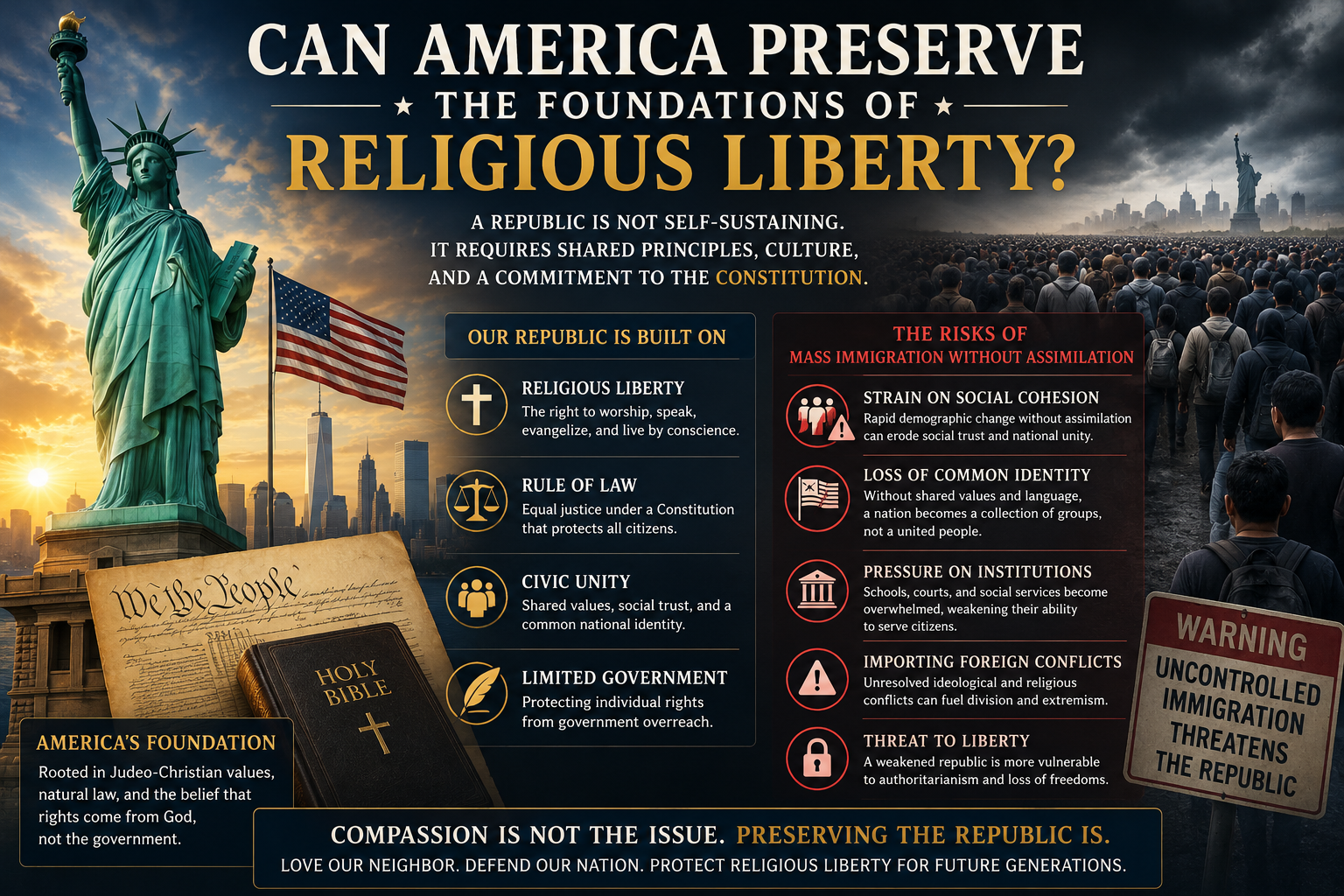
The answer is deeply connected to the constitutional and moral framework inherited from the Founding Fathers — one heavily shaped by Judeo-Christian moral philosophy, natural law traditions, and the belief that rights come from God rather than from the state.
America’s tradition of religious liberty did not arise in a vacuum. It developed within a civilization shaped by biblical concepts of human dignity, individual conscience, equality before the law, and limits on government power.
This does not mean Christians are morally superior to others, nor does it justify hatred toward Muslims or immigrants. Christians are called to love their neighbor and to recognize the dignity of every person.
That is not Islamophobia. It is a serious discussion about national identity, civic cohesion, and the long-term preservation of the American constitutional order.
However, nations also have a legitimate interest in preserving the cultural and constitutional foundations that make liberty possible. A republic cannot endure indefinitely without some degree of shared civic identity, social trust, and commitment to common principles.
The concern, therefore, is not immigration itself. The concern is whether America can maintain the philosophical and constitutional framework that sustains religious liberty if assimilation into that framework weakens over time.
Ironically, many Americans now take for granted freedoms that millions of Christians across the Muslim world still lack: the ability to openly worship, build churches, evangelize, convert freely, and publicly proclaim their faith without fear.
How the Muslim world tolerates Christianity: https://markslavik.com/practicing-christianity-safely/
As Christians, we know that hatred toward outsiders is morally wrong. Christ calls us to love our neighbor, as powerfully reflected in the Parable of the Good Samaritan. The question is not whether America should hate outsiders or reject people because of their faith or ethnicity.
Rather, the question is whether America can preserve the constitutional, moral, and cultural foundations that made religious liberty and freedom possible in the first place.