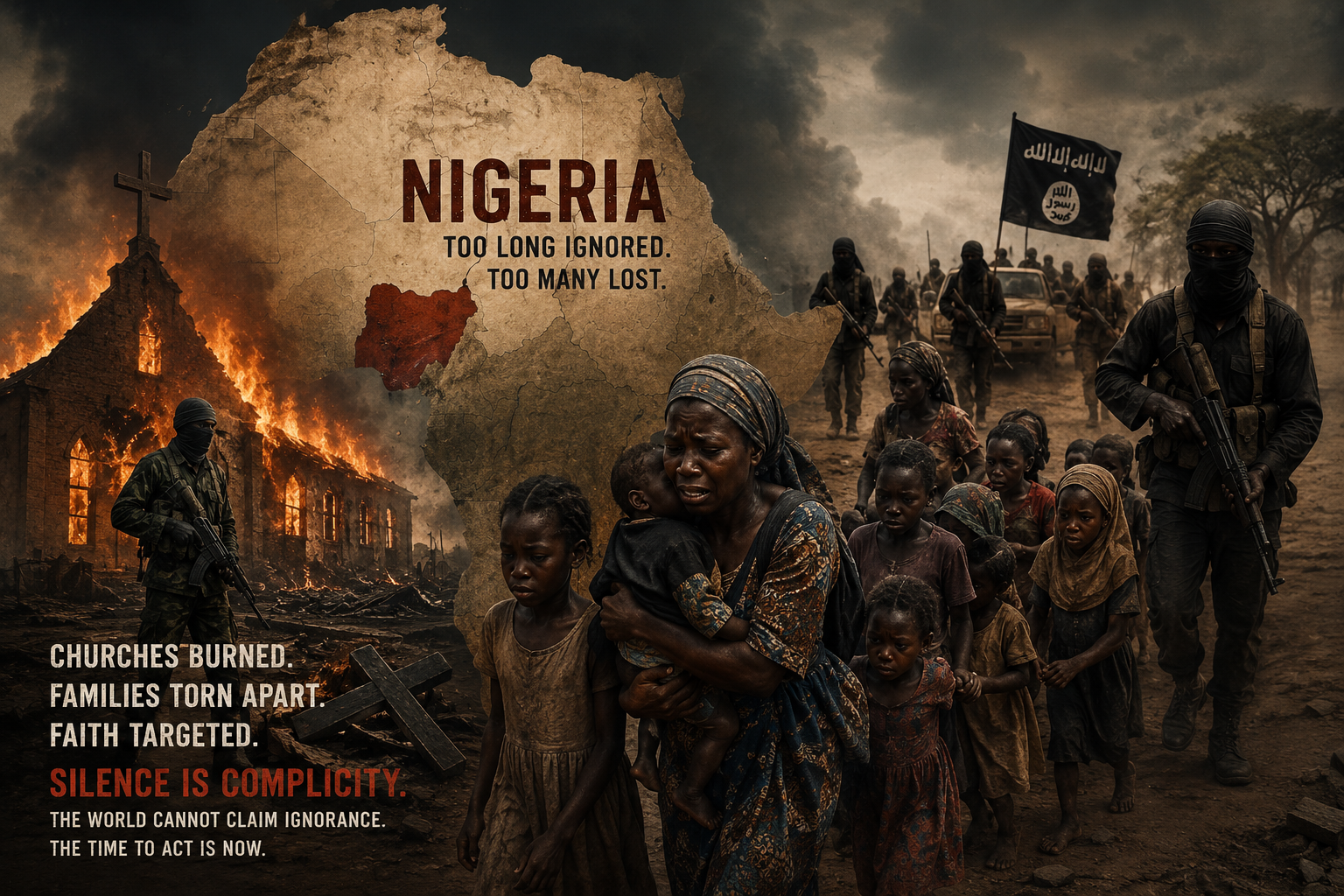
The elimination of a senior ISIS leader is a significant victory—but the suffering of Nigeria’s Christian communities is far from over.
For too long, the killers of Nigerian Christians believed the world was not watching. This operation sends a different message: those who persecute, terrorize, and murder the innocent can be found, and they can be stopped.
“What is happening to Christians in Nigeria is nothing short of a jihad clothed in many names: terrorism, kidnappings, killer herdsmen, banditry, and militia violence.” — Bishop Wilfred Anagbe of Nigeria
In May 2026, a joint U.S.-Nigerian operation eliminated Abu-Bilal al-Minuki, described by both governments as the second-highest-ranking leader in ISIS globally and one of the most important terrorist targets in Africa.
His death represents a significant strategic victory against the terrorist networks that have terrorized Nigeria for years and destabilized an entire region. The operation demonstrated a renewed commitment by the United States and Nigeria to confront extremist violence at its source rather than merely react to its consequences.
For many Christians, however, this operation carries an even deeper significance.
Nigeria has become one of the most dangerous places in the world to be a Christian. For more than a decade, Christian communities across northern and central Nigeria have endured mass killings, kidnappings, village raids, church burnings, forced displacement, and abductions for ransom. Terrorist organizations such as Boko Haram and ISIS-West Africa Province (ISWAP) have attacked churches during worship services, murdered pastors and priests, abducted Christian schoolchildren, and destroyed entire farming communities.
In many cases, survivors report that attackers deliberately targeted Christian villages, giving residents the choice to flee, convert, or face violence. Human rights organizations and religious freedom advocates have documented thousands of deaths and millions of displaced persons over the past decade.
Particularly troubling has been the violence in Nigeria’s Middle Belt, where Christian farming communities often find themselves on the front lines of attack.
- Entire villages have been burned to the ground. Families have been murdered in their homes.
- Clergy have been kidnapped or killed.
- Many communities live under constant fear of nighttime raids, forcing families to abandon ancestral lands and livelihoods.
The cumulative effect is not merely the loss of life. It is the destruction of churches, schools, businesses, communities, and a way of life that has existed for generations.
The tragedy in Nigeria is not measured only by the number of lives lost. It is measured by empty churches, burned villages, orphaned children, grieving families, and entire communities living in fear simply because of their faith.
Religious persecution is not an abstract concept in Nigeria. It has names, faces, families, and graves. Every attack leaves behind a community struggling to rebuild what terror sought to destroy.
While the elimination of a senior ISIS leader will not erase years of suffering, it is a meaningful step toward justice. Every terrorist network disrupted means fewer attacks planned, fewer villages targeted, and a greater chance that Nigeria’s Christians—and all innocent civilians—can live, worship, and raise their families in peace.
At a minimum, this operation demonstrates that the United States and its partners are willing to confront the terrorist organizations responsible for much of the violence. For Nigeria’s persecuted Christian communities, that offers a measure of hope that the world is finally paying attention.
The world cannot claim ignorance. The evidence is overwhelming, the victims are real, and the cost of silence is measured in lives.
“The martyrs of today are more numerous than those of the first centuries.” — Pope Francis
Sources
• AFRICOM (May 2026)
• Reuters (May 2026)
• USCIRF Annual Report (2025)
• Open Doors World Watch List (2026)
• Aid to the Church in Need: Religious Freedom in the World Report
• Bishop Wilfred Anagbe Congressional Testimony (March 2025)