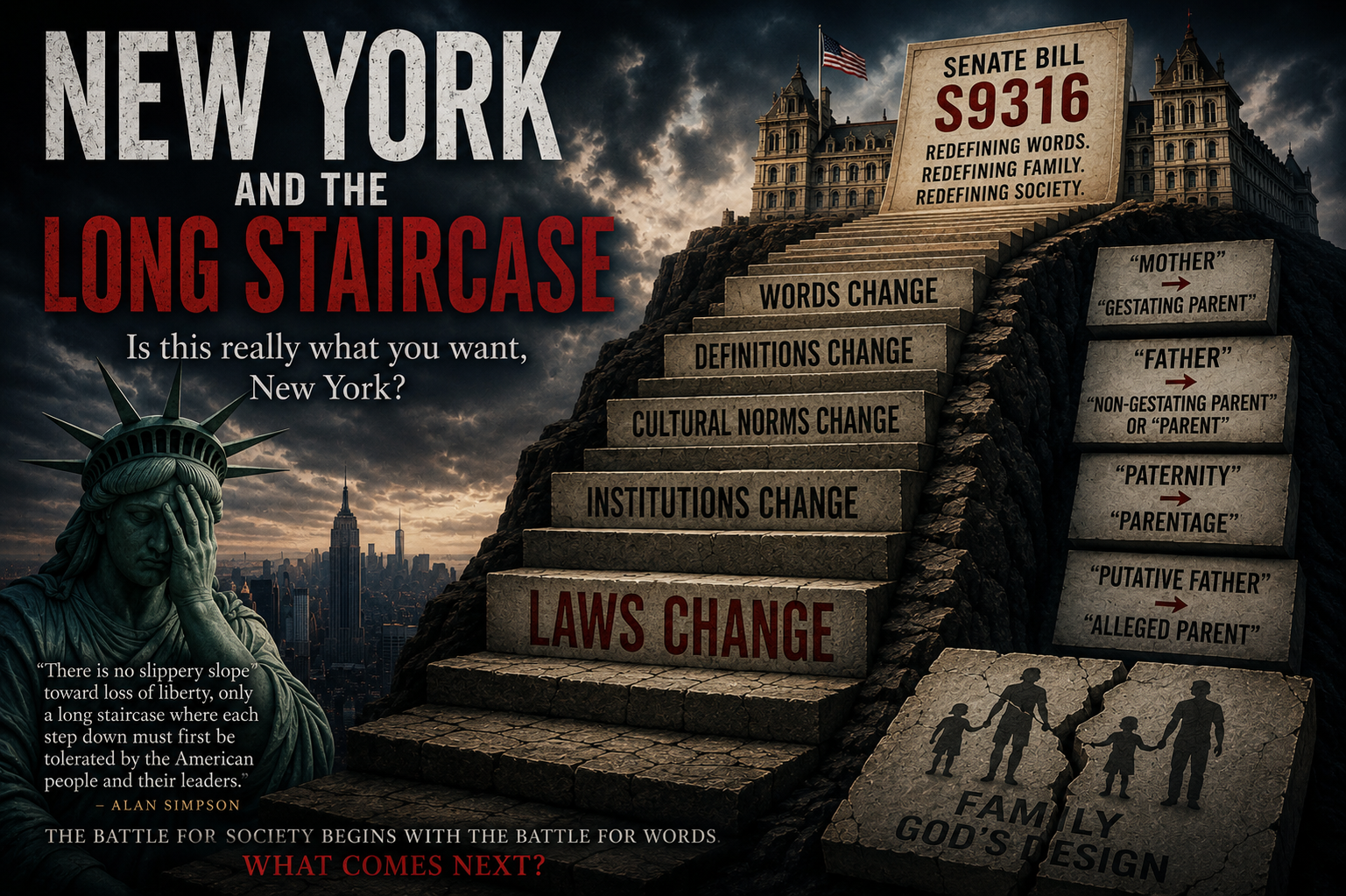
Is this really what you want, New York?
Societies rarely change overnight. Most major cultural shifts begin with something far less dramatic: the gradual redefinition of words, values, and moral assumptions.
That is why a recently proposed New York bill deserves attention far beyond Albany.
New York Senate Bill S9316 would replace many traditional references to “mother” and “father” in state law with gender-neutral terminology. Under the proposal, terms such as “mother” could be replaced by “gestating parent,” “father” could be replaced by “non-gestating parent” or simply “parent,” and “paternity” proceedings would be replaced by “parentage” proceedings.
The concern is not simply about new legal terminology. It is about a much larger question: What happens when society begins redefining foundational words that have described human relationships for thousands of years?
One of the oldest tactics in history is not open confrontation with truth but the gradual redefinition of it.
First words change.
Then definitions change.
Then cultural norms change.
Finally, laws change.
What appears to be a sudden transformation is often the result of a long staircase of small compromises, each tolerated because it seemed insignificant at the time.
As language changes, identity and cultural norms often follow. What was once understood as objective and rooted in nature, faith, and tradition increasingly becomes subjective and self-defined. Schools, corporations, media, and government institutions then adopt the new framework, shaping how future generations understand truth, morality, family, and human dignity.
This concern is not new.
Alan Simpson once observed: “There is no slippery slope toward loss of liberty, only a long staircase where each step down must first be tolerated by the American people and their leaders.”
The question is whether New York is taking another step down that staircase.
From a Christian perspective, words such as mother and father are not merely bureaucratic labels. They reflect realities rooted in nature, family, and ultimately God’s design for the human person. When those realities are replaced with increasingly clinical or ideological language, many Christians worry that society is not merely updating terminology—it is redefining the family itself.
Throughout history, significant cultural shifts frequently originate with changes in language. Altering the words we use leads to shifts in how people perceive and think about the world. As thinking evolves, it influences laws, institutions, and cultural norms built on those ideas.
This process often begins with language. Terms like marriage, family, mother, father, freedom, and truth may be reinterpreted or assigned new meanings. Once language shifts, related concepts of identity and culture tend to follow. What was once seen as objective and rooted in nature, faith, or tradition often becomes subjective and self-defined.
As these emerging ideas gain traction, institutions start to embody them. Schools, corporations, media, and government policies adopt the new perspectives, shaping future generations’ understanding of truth, morality, and human dignity. Over time, the family—traditionally the primary transmitter of faith, virtue, and values—may weaken or become marginalized.
Writers such as G. K. Chesterton, Fulton Sheen, and Pope Benedict XVI warned that societies lose their bearings when they lose confidence in objective truth. Benedict XVI famously cautioned against a “dictatorship of relativism” in which truth becomes whatever society decides it is at the moment.
The challenge for Christians is not to resist every change. The challenge is to discern whether change moves society closer to truth or further away from it. Because the battle for society often begins with the battle for words. And when words such as mother and father become negotiable, many Americans are left asking: What comes next?
Is this really what you want, New York?