The United States Declaration of Independence was adopted by the Continental Congress on July 4, 1776, but the signing process was more complex than many realize.
On July 2, 1776, the Second Continental Congress voted for independence from Great Britain. Two days later, Congress approved the final wording of the Declaration. This is why Americans celebrate Independence Day on July 4.
Ultimately, fifty-six men representing the thirteen colonies signed the Declaration. The signers ranged from twenty-six-year-old Edward Rutledge of South Carolina to seventy-year-old Benjamin Franklin of Pennsylvania. Forty-two of the signers were younger than fifty, and twenty were under forty. They were merchants, lawyers, farmers, physicians, and public servants who risked their fortunes, reputations, and lives.
As Benjamin Franklin reportedly remarked after the signing: “We must, indeed, all hang together, or most assuredly we shall all hang separately.”
The Declaration was not signed by elderly statesmen reflecting upon lives already lived. It was signed largely by men in the prime of their lives who understood the tremendous personal cost of their actions. For many of the signers, patriotism was not merely a sentiment. It was a willingness to sacrifice everything for the principles expressed in the Declaration: life, liberty, and the pursuit of happiness.
One cannot help but ask whether today’s leaders would be willing to risk so much for the nation they serve.
Patriotism Above Party
Theodore Roosevelt offered one of the clearest definitions of patriotism: “Patriotism means to stand by the country. It does not mean to stand by the president or any other public official insofar as he himself stands by the country.”
Long before Roosevelt, George Washington warned Americans about the dangers of excessive partisanship. In his 1796 Farewell Address, he cautioned: “The nation which indulges toward another an habitual hatred or an habitual fondness is in some degree a slave.” Washington understood that factionalism could divide and ultimately weaken the Republic.
A similar spirit characterized much of the Kennedy era. When President John F. Kennedy urged Americans to “let us not seek the Republican answer or the Democratic answer, but the right answer,” he spoke at a time of relatively high trust in institutions, strong Cold War unity, and broad agreement on America’s role in the world. Conservative Democrats and liberal Republicans were common. Patriotism was widely regarded as a civic virtue shared across party lines.
The assumption underlying Kennedy’s appeal was simple: Americans were citizens first and partisans second.
What Gallup Reveals Today
Recent polling suggests that this shared understanding of patriotism has weakened. Gallup’s long-running surveys on national pride indicate that Republicans have generally maintained higher and more stable expressions of national pride, while Democrats’ reported pride has fluctuated more significantly depending on political circumstances and which party controls the White House.
This observation should be approached carefully. The data support the conclusion that expressions of national pride differ between political groups. The data do not necessarily prove that one side loves America more than the other. However, conservatives generally view patriotism as a commitment to the traditions and underlying philosophies on which the country was founded, while liberals view progress and change, especially in inclusivity and equity, as the underpinning of their philosophies.
Even so, the findings raise important questions. If patriotism rises and falls primarily according to political outcomes, then perhaps patriotism has become increasingly intertwined with partisanship. True patriotism is tested not when our preferred leaders govern, but when they do not. Love of country that survives disappointment may be among the strongest forms of civic virtue.
What Changed?
The decline of a shared understanding of patriotism did not occur suddenly. Most historians and political analysts describe it as a gradual deterioration that accelerated during the late twentieth century.
Cultural Upheaval
The social upheaval of the 1960s and 1970s profoundly reshaped American society. The civil rights movement, the Vietnam War, political assassinations, campus unrest, Watergate, and rapid cultural change weakened confidence in many traditional institutions.
Before this period, Americans generally shared broad agreement regarding patriotism, civic identity, religious morality, and trust in institutions. Over time, suspicion increasingly shifted toward government, media, universities, churches, and corporations.
People no longer viewed the world through the same cultural lens.
America began to change when we stopped believing our political opponents were simply mistaken and started believing they were dangerous. A republic cannot endure when disagreement turns into dehumanization, when contempt replaces civility, and when fellow citizens become enemies rather than Americans with differing convictions.
The Collapse of Shared Moral Foundations
For much of American history, even many non-religious citizens operated within a broadly Judeo-Christian moral framework grounded in objective truth, duty, restraint, forgiveness, dignity, and civic virtue.
As secularization accelerated during the late twentieth century, consensus weakened regarding the nature of truth, the meaning of freedom, the demands of justice, and even what it means to be human.
Once a society loses shared moral reference points, political disagreements cease to feel like ordinary policy debates. They increasingly resemble existential struggles over identity, survival, and the future of the nation itself.
Technology and the Age of Outrage
Rapid technological change accelerated these divisions. The rise of the internet, smartphones, social media, and algorithm-driven news feeds fundamentally altered public discourse. What began as a tool for connection evolved into a digital ecosystem increasingly designed to capture attention, amplify emotion, and maximize engagement. Anger became profitable. Nuance struggled to compete with outrage. Tribalism often displaced thoughtful debate.
Social media gave everyone a voice. Algorithms taught many to use it without wisdom, restraint, or charity.
When Politics Became Identity
Historically, most Americans viewed politics as important but secondary to deeper sources of identity such as faith, family, community, and nation. As traditional institutions weakened, many individuals increasingly sought belonging, purpose, and meaning elsewhere. For some, politics filled that vacuum. Political affiliations became more than policy preferences. They became identities.
Once politics becomes intertwined with personal identity, disagreement no longer feels like a debate over ideas. It feels like an attack on one’s values and dignity. Compromise begins to feel like betrayal. Opponents increasingly appear dangerous rather than mistaken.
The Crisis of Institutional Trust
Confidence in American institutions has steadily declined in recent decades. Trust has weakened not only in Congress and the media, but also in universities, corporations, churches, public health agencies, and even the integrity of elections. As trust erodes, suspicion naturally grows.
A constitutional republic depends upon shared truth, civic virtue, and confidence that institutions are at least attempting to serve the common good. When truth becomes fragmented and institutions appear detached from moral foundations, society becomes vulnerable to cynicism, tribalism, and division.
The Loss of the Moral Middle Ground
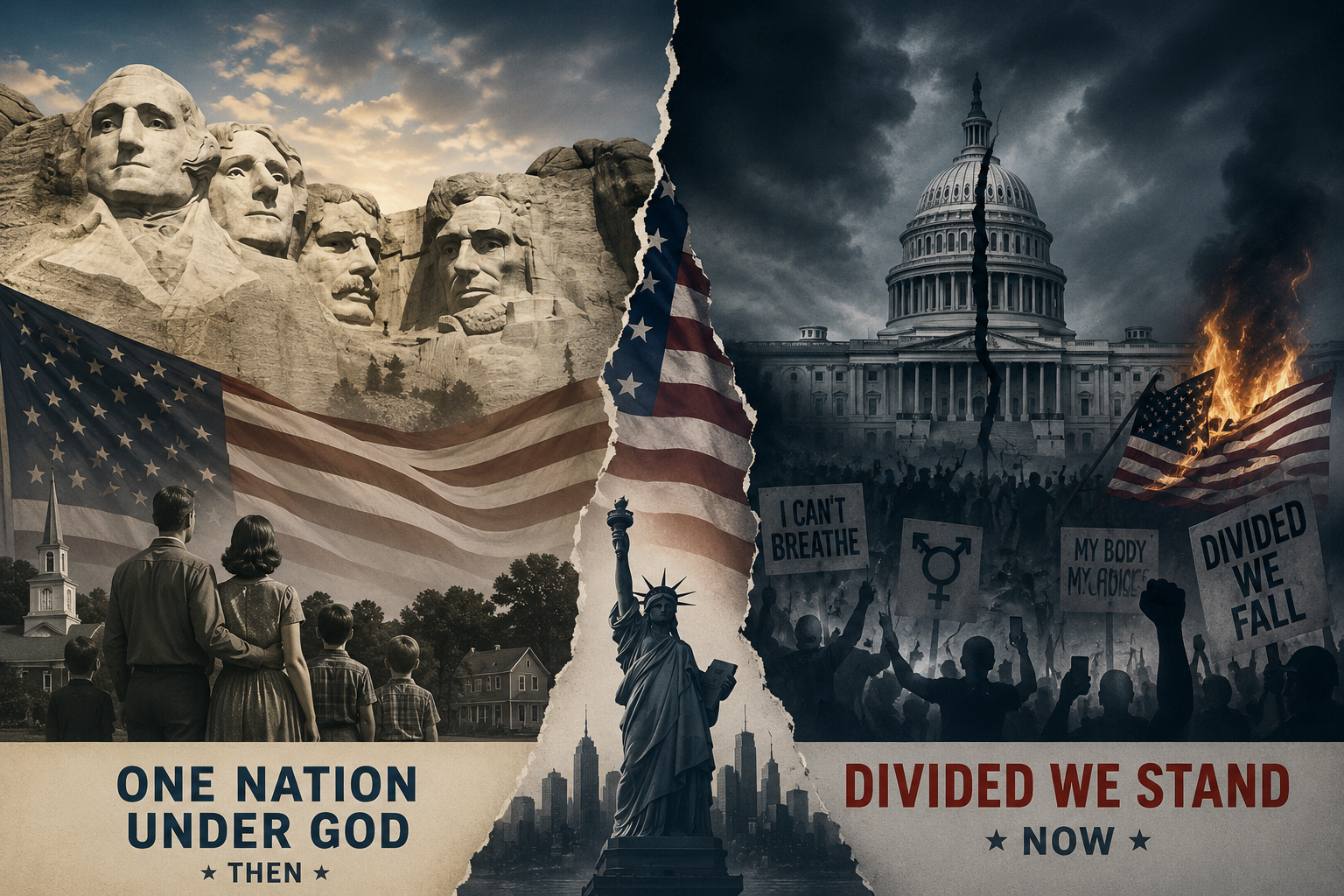
America has never been perfectly unified. Its history includes civil war, segregation, labor unrest, riots, fierce religious disagreements, and deeply partisan politics. Conflict itself is not new. What is different today is the speed, intensity, and scale with which division spreads.
Technology, social media, and twenty-four-hour political coverage magnify every controversy and reinforce every grievance. At the same time, America has experienced the erosion of a shared moral language rooted in faith, civic virtue, and common cultural assumptions. Nowhere is this tension more evident than in disputes over principles traditionally understood to arise from moral natural law, particularly regarding abortion, euthanasia, gender identity, and the structure of the family.
Increasingly, the nation no longer debates merely solutions or policies. It debates truth, identity, and reality itself.
G. K. Chesterton warned that when societies abandon transcendent truth, politics often becomes a substitute religion. Opponents cease to be viewed as merely mistaken and instead become heretics. Compromise becomes moral surrender. Political power becomes ultimate.
The ability to disagree respectfully survives only when a society shares deeper commitments such as belief in human dignity, limits on power, civic virtue, and loyalty to truth above tribal identity.
Without those foundations, politics gradually transforms from civic debate into cultural warfare.
A Closing Reflection
Patriotism is not the absence of disagreement. The American experiment has always involved vigorous debate. Patriotism means recognizing that despite our differences, we share a common inheritance and a common responsibility to preserve the Republic for future generations.
Theodore Roosevelt’s words remain as relevant today as when he first spoke them: “Patriotism means to stand by the country. It does not mean to stand by the president or any other public official insofar as he himself stands by the country.”
Patriotism is not tested when our preferred leaders govern. Patriotism is tested when they do not.
Love of country that survives disappointment may be the strongest form of civic virtue.
What kind of patriots will we choose to be?”
Selected Sources and References:
The Declaration of Independence, National Archives, https://www.archives.gov/founding-docs/declaration
George Washington, “Farewell Address” (1796), Yale Law School Avalon Project, https://avalon.law.yale.edu/18th_century/washing.asp
John F. Kennedy, remarks to the National Association of Manufacturers, January 1962:
“Let us not seek the Republican answer or the Democratic answer, but the right answer.”
The American Presidency Project, https://www.presidency.ucsb.edu/
Theodore Roosevelt, “The Duties of American Citizenship” (1893):
“Patriotism means to stand by the country. It does not mean to stand by the president or any other public official insofar as he himself stands by the country.”
Theodore Roosevelt Center, Dickinson State University.
Gallup, “American Pride Slips to New Low” (2025), https://news.gallup.com
Gallup, “Extreme Pride in Being American Remains Near Record Low” (2023), https://news.gallup.com
Robert D. Putnam, Bowling Alone: The Collapse and Revival of American Community (New York: Simon & Schuster, 2000).
Jonathan Haidt, The Righteous Mind: Why Good People Are Divided by Politics and Religion (New York: Pantheon Books, 2012).
Pew Research Center, research on national identity, civic engagement, and political polarization, https://www.pewresearch.org
Thomas Aquinas, Summa Theologiae, particularly discussions on natural law and the common good (I-II, Questions 90–97).
Catechism of the Catholic Church, §§2238–2240, concerning duties toward civil authorities and the common good.
G. K. Chesterton, Orthodoxy (1908) and related essays addressing truth, morality, and modern society.
Yuval Levin, A Time to Build: From Family and Community to Congress and the Campus, How Recommitting to Our Institutions Can Revive the American Dream (New York: Basic Books, 2020).
Arthur C. Brooks, Love Your Enemies: How Decent People Can Save America from the Culture of Contempt (New York: Broadside Books, 2019).