Should a political candidate’s personal decisions matter when evaluating their judgment and character?
I believe they deserve scrutiny, but they also deserve context.
I began investigating Amy Acton’s driving record after learning about a 1993 conviction for driving under suspension or revocation. That happened more than 30 years ago. Normally, I would question its relevance today.
But when examining a candidate’s history, I believe it is reasonable to look beyond any single incident and consider the record as a whole.
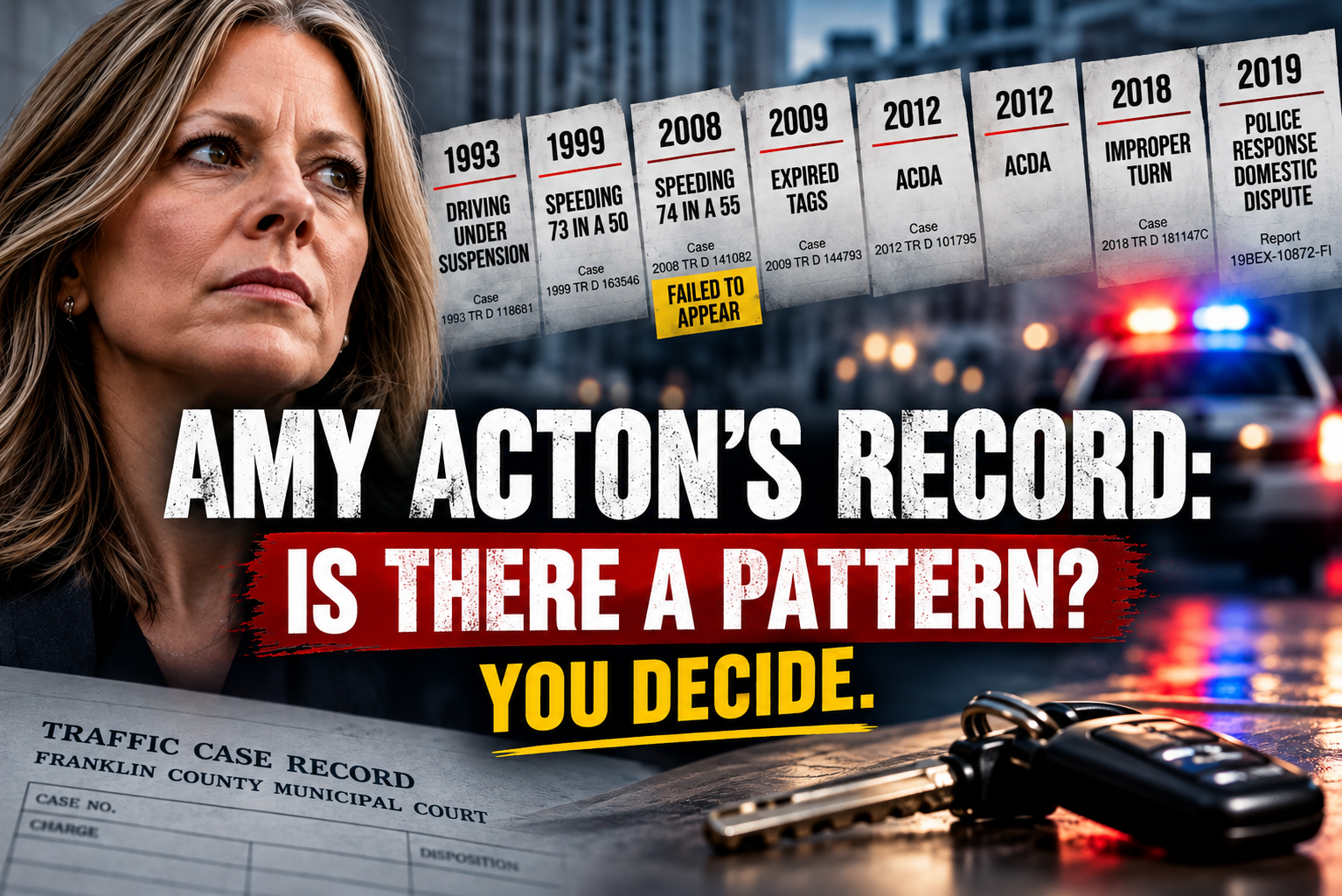
Here are six traffic cases identified in court records:
- 1993: Driving under suspension or revocation – Case 1993 TR D 118681.
- 1999: Speeding, 73 mph in a 50-mph zone – Case 1999 TR D 163546.
- 2008: Speeding, 74 mph in a 55-mph zone – Case 2008 TR D 141082.
- 2009: Failure to register vehicle / expired tags – Case 2009 TR D 144793.
- 2012: Assured Clear Distance Ahead (ACDA), a traffic violation concerning safe stopping distance – Case 2012 TR D 101795.
- 2018: Improper turn – Case 2018 TR D 181147C.
Two questions remain about the earlier incidents.
First, why was Acton’s license suspended in 1993? I have not established the underlying reason.
Second, the 2008 speeding case reportedly included a failure to appear in court. If confirmed by the docket, why was the hearing missed, and how was the matter resolved?
There is also a separate 2019 police report.
Bexley police responded to a domestic dispute involving Acton and her husband. The report described an argument, a broken mirror, and statements concerning alcohol and prescription medication. It also documented that Acton went to the garage intending to leave in her vehicle, but her husband persuaded her not to. (Reference #19BEX-10872-FI)
These incidents do not mean that Amy Acton is a bad person, but for me, they indicate that she is not the best choice to be Ohio’s governor. Previously, I have discussed my concerns regarding her alignment with Christian principles and her lack of executive experience relevant to Ohio’s future.
But I do believe candidates for public office should be subject to careful, fact-based examination.
Are these isolated incidents spread over many years, or do they suggest a broader pattern?
Review the records. Consider the explanations. Draw your own conclusions.