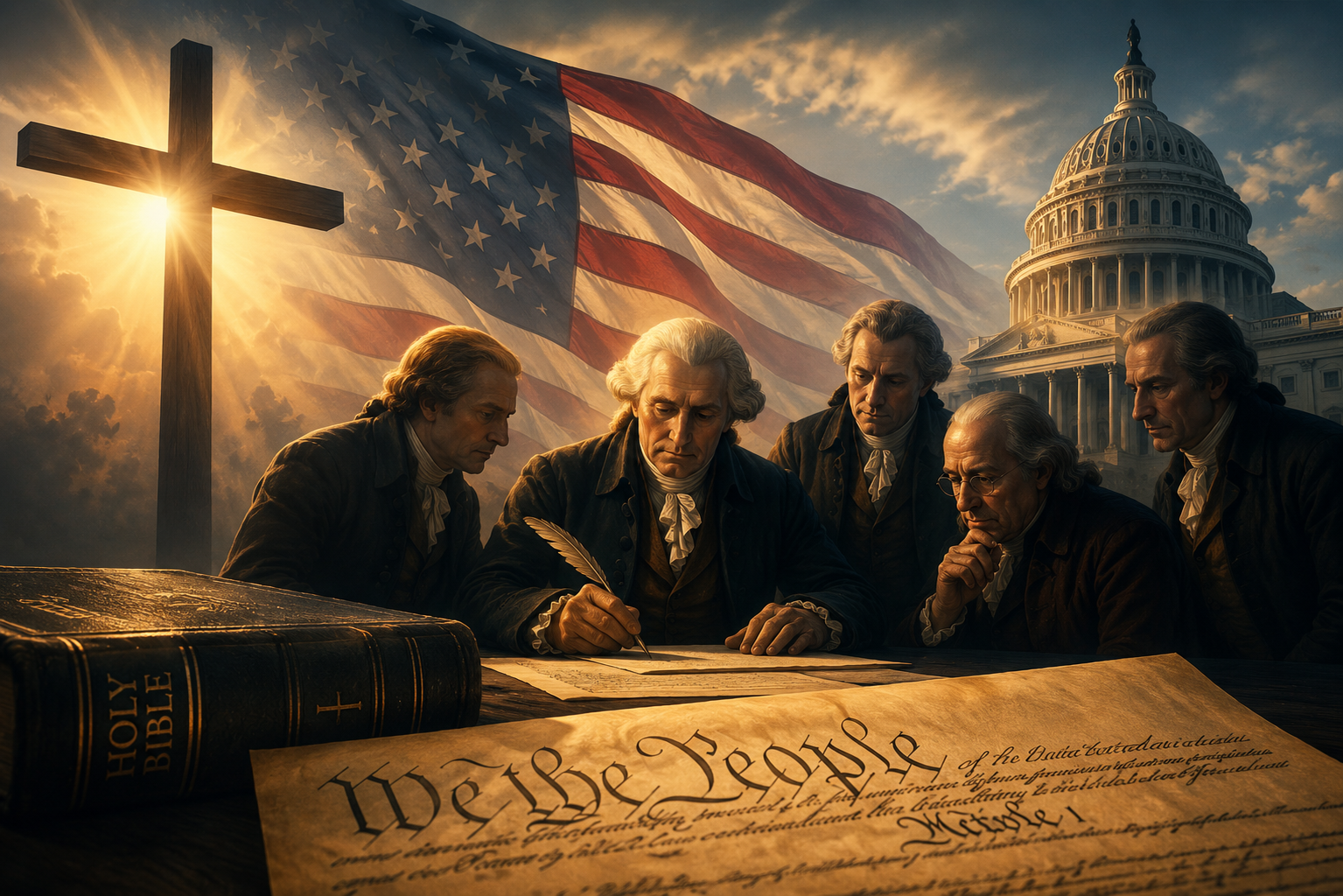
As America approaches the 250th Anniversary of the Declaration of Independence, it is worth asking a simple but important question:
Was America founded as a Christian nation?
The answer is yes, but not in the way most people expect.
Christianity guided America’s Founding Fathers not by establishing a national church but by shaping the moral principles on which they built a constitutional republic. The Declaration of Independence, the Constitution, and the Founders’ writings repeatedly affirm that our rights come from God, that liberty requires virtue, and that self-government depends on a moral and religious people.
The Founders did not create a theocracy; instead, they founded a constitutional republic based on principles heavily inspired by Christianity, natural law, and the belief that our rights originate from our Creator, not the government.
George Washington understood this truth. In his Farewell Address, he warned: “Of all the dispositions and habits which lead to political prosperity, religion and morality are indispensable supports.”
More than three decades later, French historian and political philosopher Alexis de Tocqueville reached a similar conclusion after studying the young American republic: “Liberty cannot be established without morality, nor morality without faith.”
These men recognized a timeless truth: freedom cannot survive without virtue, and virtue cannot flourish without a moral foundation.
A Christian nation is not a nation with an official church or a government that compels religious belief. Rather, it is a nation whose culture, institutions, and laws have been profoundly shaped by Christianity while safeguarding the religious liberty of every citizen.
Measured by that historical standard, America’s Christian heritage is unmistakable. The Declaration of Independence grounds our rights in our Creator. The Constitution established limited government because the Founders understood both the blessings and the dangers of human nature. America’s legal traditions, educational institutions, hospitals, charities, and countless civic organizations were profoundly shaped by Christian thought.
For these reasons, America has long been recognized as a Christian nation—not because it established Christianity by law, but because Christianity helped shape the nation’s character. Even the Supreme Court acknowledged this historical reality. In Church of the Holy Trinity v. United States (1892), Justice David Josiah Brewer wrote: “This is a Christian nation.”
Unfortunately, much confusion surrounds the term Christian nationalism. The term is often defined differently depending on who uses it. Some use it to describe a government that grants Christianity legal preference or special privileges over other religions. Others use it much more broadly to describe Christians who simply acknowledge America’s Christian heritage or allow their faith to influence their participation in public life.
Charlie Kirk argued that the phrase is frequently used as a political label to marginalize or silence Christians who engage in politics or defend America’s Christian heritage.
Recognizing America’s Christian heritage is not the same as advocating a government that establishes a religion or compels religious belief. America’s Founders rejected both religious coercion and moral relativism. Instead, they created a republic that protects religious liberty and assumes that its citizens will govern themselves according to moral principles.
As practicing Christians and faithful citizens, we should:
- Recognize and appreciate that America was founded upon principles deeply influenced by Christianity.
- Understand that liberty depends upon a moral and religious people.
- Participate actively in civic life rather than retreat from it.
- Evaluate public policy against objective moral principles.
- Defend religious liberty for every citizen
- Vote according to a conscience informed by faith.
- Encourage a culture where virtue, personal responsibility, and respect for God strengthen the republic.
America has never been perfect. Slavery, segregation, and other injustices remind us that we have often fallen short of our founding ideals. Yet those very injustices were challenged and ultimately overcome by men and women who appealed to the Christian principles of human dignity, equality, and justice upon which this nation was built.
John Adams offered perhaps the clearest warning of all: “Our Constitution was made only for a moral and religious People. It is wholly inadequate to the government of any other.”
As we celebrate America’s 250th birthday, let us remember that preserving liberty requires more than defending the Constitution. It requires preserving the moral character upon which the Constitution depends.
I encourage every American to spend a few minutes watching Charlie Kirk’s presentation, “Are We a Christian Nation?” His distinction between a Christian nation and Christian nationalism is thoughtful, historically grounded, and well worth considering. https://www.youtube.com/watch?v=A6R_-AvCUsQ&utm_source=chatgpt.com