By Day 2 on Milford, the routine began to feel like a well-oiled military operation—just a lot quieter and with better scenery.
At 7:00 a.m., when the diesel generators kicked on, everyone hustled to the dining hall to prepare lunch for the day’s hike. One critical rule: don’t forget the gummy bears. Later in the day, you’ll need that sugar boost—these are unenhanced gummies 😊.
There was no shortage of food at the lodges, but from an American perspective, the coffee required a slight adjustment. As in much of Europe, there were no oversized drip coffee makers or trusty Mr. Coffee machines. Instead, they used single-cup machines, which, admittedly, made a far better cup of coffee. And out on the trail, the guides would occasionally set up coffee and tea stops. Hallelujah!
Breakfast was hearty—eggs, bacon, beans, and tomatoes—before everyone retrieved their gear from the drying room, packed up, and gathered outside the lodge for the morning briefing.
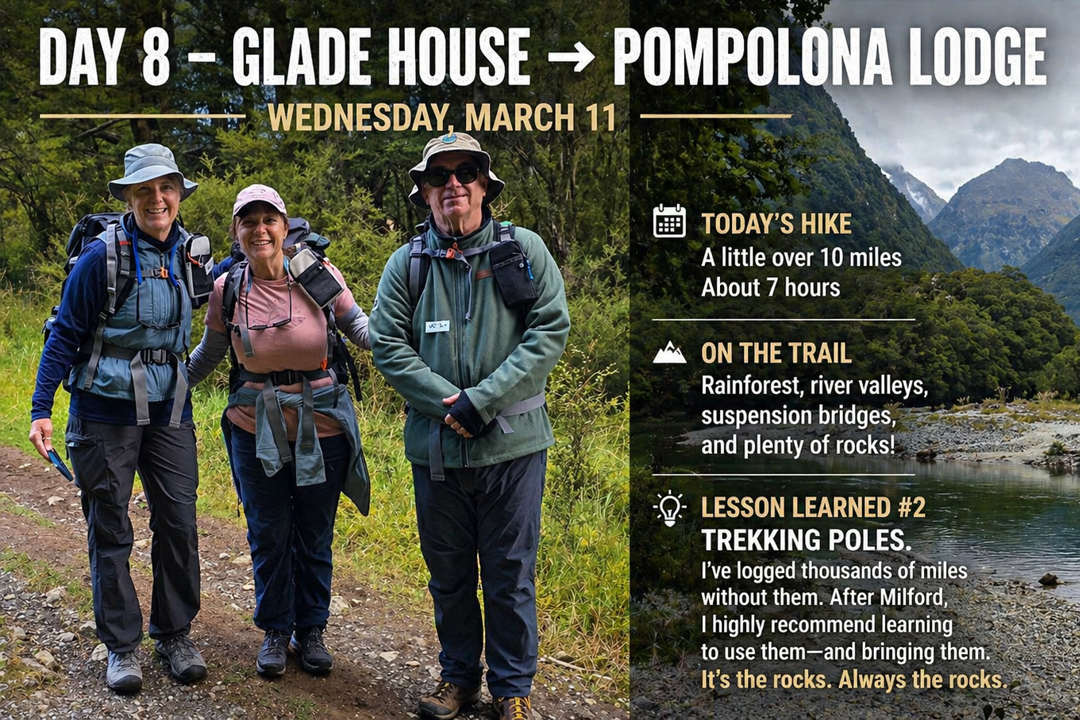
Today’s hike was a little over ten miles and took about seven hours. As my second-oldest granddaughter, Molly, likes to remind me: “It’s not a race, Grandpa.” Wise words. Given the group’s demographics, we expected to finish in the last quarter of hikers, and we were fine with that.
On the Milford Track, you walk at your own pace… and eventually arrive at the next lodge.
I should add: the phrases “you’re almost there” and “it’s just around the corner” should be outlawed in hiking households. Rarely accurate. Never appreciated.
Compared with what was coming tomorrow—known simply as Pass Day—today’s trail was relatively tame. The path wound through dense rainforest, crossed suspension bridges, and followed beautiful river valleys. But the final stretch turned uphill and ended at Marlene’s Creek, a wide, dry riverbed filled with massive boulders.
At the time, it just looked like a rather nasty part of the trail. Looking back, we were too tired to understand that it was a foreshadowing of our day tomorrow.
Lesson learned #2: Trekking poles. I’ve logged thousands of hiking miles without ever using them. After Milford, I highly recommend learning how to use them—and bringing them. It’s the rocks. Always the rocks.