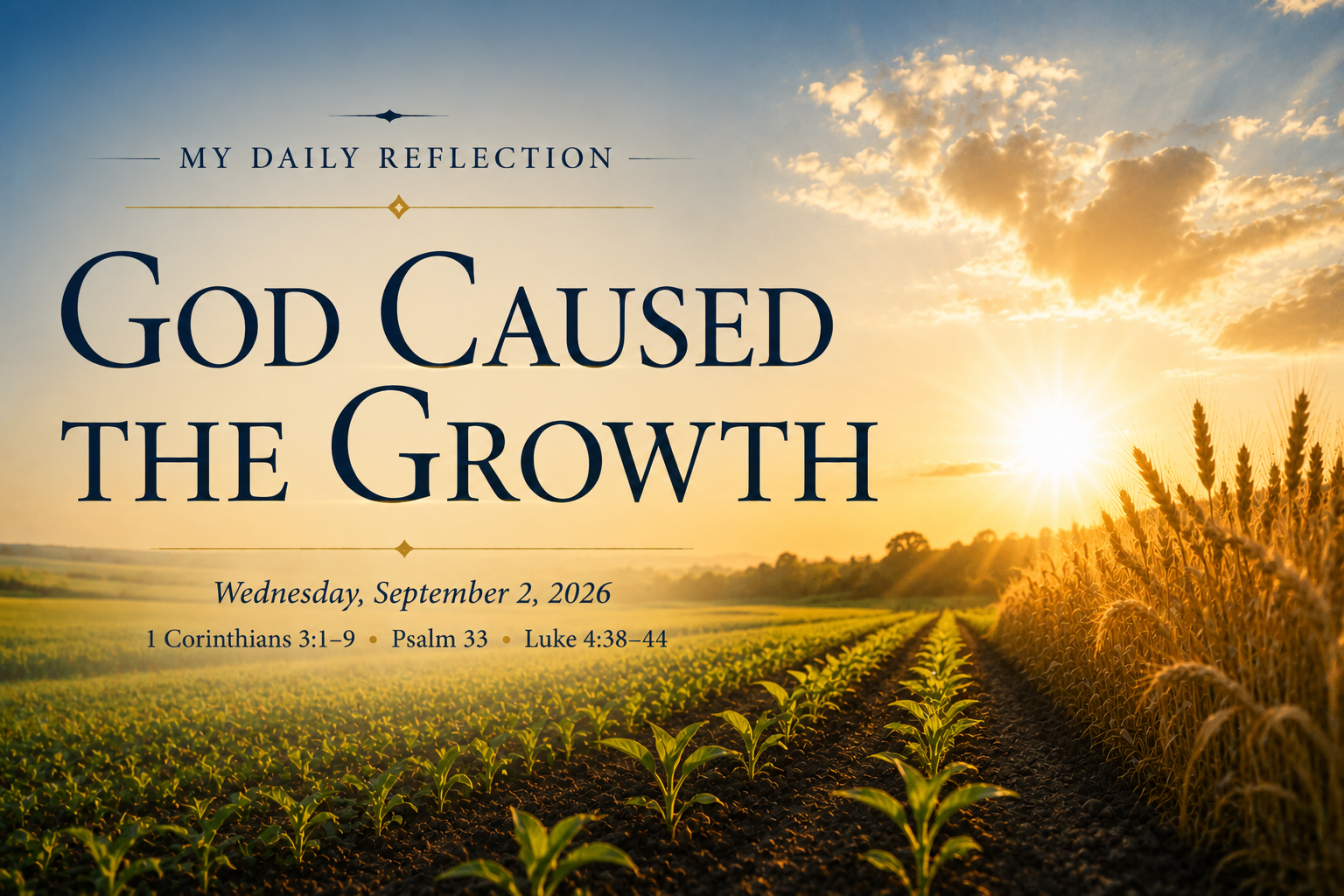
My Daily Reflection
Wednesday, September 2, 2026
1 Corinthians 3:1–9 • Psalm 33 • Luke 4:38–44
“God caused the growth.” — 1 Corinthians 3:6
Yesterday, Saint Paul told us that “we have the mind of Christ.” Today he gives us a test of whether that mind is actually beginning to form us.
Paul tells the Corinthians that he still cannot speak to them as spiritually mature Christians. Why?
Not because they lack knowledge. Not because they haven’t heard the Gospel.
Because there is still jealousy and rivalry among them.
Some say, “I belong to Paul.” Others, “I belong to Apollos.”
Paul’s response is striking: Stop making it about people, “I planted, Apollos watered, but God caused the growth.”
We have responsibilities. We have work to do. But God produces the growth.
Spiritual Maturity Is More Than Knowing
There is a natural connection with yesterday’s reflection.
Having the mind of Christ isn’t demonstrated by how much Scripture I know or how strongly I defend my beliefs.
It should eventually change how I treat people.
St. John Chrysostom saw Paul’s criticism of the Corinthians in precisely this way. Their rivalry revealed that they were still spiritually immature. He emphasizes that Paul and Apollos could accomplish nothing apart from “God that gives the increase.” Their different roles were never supposed to become reasons for division.
That’s worth considering today.
We can become attached to personalities—even good ones.
A priest. A bishop. A theologian. A political leader. A Catholic commentator. A movement.
Paul reminds us: They may plant. They may water. But only God gives the growth.
The moment our loyalty to a person begins dividing us from other Christians, something has gone wrong.
Then Jesus Shows Us Something Else
Today’s Gospel continues directly from yesterday.
Jesus leaves the synagogue and enters Simon Peter’s house. Simon’s mother-in-law is seriously ill. They ask Jesus to help her, and He heals her.
Then something beautiful happens: “She got up immediately and waited on them.”
Her response to receiving Christ’s gift is service.
That is another sign of spiritual maturity.
Grace isn’t simply something I receive for myself. God’s gifts should eventually flow through me toward someone else.
Then word spreads.
By sunset, people are bringing the sick to Jesus. Luke gives us a small detail that is easy to overlook:
Jesus lays His hands on each of them.
Not simply the crowd.
Each person.
Christianity speaks about humanity, nations, cultures and communities—but Christ encounters persons.
The suffering person standing before Him matters.
That is worth remembering when we are tempted to reduce people to categories: conservative, liberal, immigrant, wealthy, poor, Catholic, Protestant, atheist—or simply someone with whom we disagree.
Christ sees the person before the label.
Something Easy to Miss
After an exhausting evening of teaching, healing and confronting evil, Jesus does something surprising.
At daybreak: He leaves and goes to a deserted place.
The crowds find Him and try to prevent Him from leaving.
Think about that.
Jesus is successful. People want Him. They want more miracles. From a human perspective, this looks like exactly where He should remain.
But Jesus says: “To the other towns also I must proclaim the good news of the Kingdom of God, because for this purpose I have been sent.”
This may be today’s most important lesson in discernment.
Not every good opportunity is God’s mission for me.
The people aren’t asking Jesus to do something evil.
They want Him to continue doing something good.
Yet Jesus leaves.
Why?
Because He knows His mission.
That’s a powerful distinction.
Sometimes discernment isn’t choosing between good and evil.
It is choosing between something good and what God is actually calling me to do.
A good opportunity can still become a distraction if it pulls me away from the responsibilities God has entrusted to me.
Why These Readings Work Together
As with yesterday, the weekday readings are progressing semi-continuously through 1 Corinthians and Luke rather than being deliberately constructed as a thematic pair.
Yet they illuminate one another beautifully.
Paul says: Don’t make yourself, Paul or Apollos the center. God gives the growth.
Jesus demonstrates: Don’t even allow popularity and success to become the center. Do the work the Father sent you to do.
Together they point toward a remarkably freeing Christian principle:
Be faithful to your responsibility. Leave the results to God.
I plant.
Someone else may water.
God determines the growth.
That doesn’t excuse poor effort. Paul calls us “God’s co-workers.” Our work matters enormously.
But the outcome ultimately belongs to Him.
Take This With You Today
When something demands your attention today, particularly something that looks worthwhile, ask two questions: “Is this a good thing?”
Then ask the harder question: “Is this what God is asking me to do?”
Those aren’t always the same question.
And when you’ve faithfully done what God has entrusted to you, resist the temptation to control everything that happens afterward.
Plant well.
Water faithfully.
Then trust God with the growth.
Question for Prayer: Lord, where am I trying to control an outcome that I should entrust to You—and where might something good be distracting me from what You are actually calling me to do?
Closing Prayer: Lord Jesus, help me recognize the work You have entrusted to me. Protect me from jealousy, rivalry, pride, distraction, and the desire to control outcomes. Give me the wisdom to know when to stay and when to move on. Help me work faithfully, serve generously, and trust You completely with the results. Amen.
Sources
- USCCB — 1 Cor 3:1–9; Lk 4:38–44
- St. John Chrysostom — Homily 8 on 1 Corinthians
- Vatican News — Word of the Day, Sept. 2