Saint Anthony of Padua
The Man Who Found His Calling After Losing His Plan.
Many recognize Saint Anthony as the patron saint of lost items. His most remarkable miracle may have been guiding numerous individuals to rediscover what truly mattered: their path back to Christ.
His real story is extraordinary:
- Wanted to become a martyr.
- Left Portugal to preach in Morocco.
- Became gravely ill and never reached his mission.
- Shipwrecked on the journey home.
- Lived in obscurity for nearly a year.
- Was unexpectedly asked to preach.
- Delivered a sermon that launched one of the greatest preaching ministries in Church history.
- Was declared a Doctor of the Church
His Early Life
Anthony was born into a wealthy and respected Portuguese family in 1195. His birth name was Fernando Martins de Bulhões. His parents expected him to enjoy status, wealth, education, and influence. Instead, at the age of 15, he entered an Augustinian monastery to devote his life to God.
Everything changed around 1220 when the bodies of five Franciscan missionaries were returned to Portugal. They had been martyred while preaching Christ in Morocco. Deeply moved by their witness, Fernando left the Augustinians to join the Franciscans, taking the name Anthony in honor of Saint Anthony the Great.
He reportedly said: “Now I know what I truly desire—to become a martyr.”
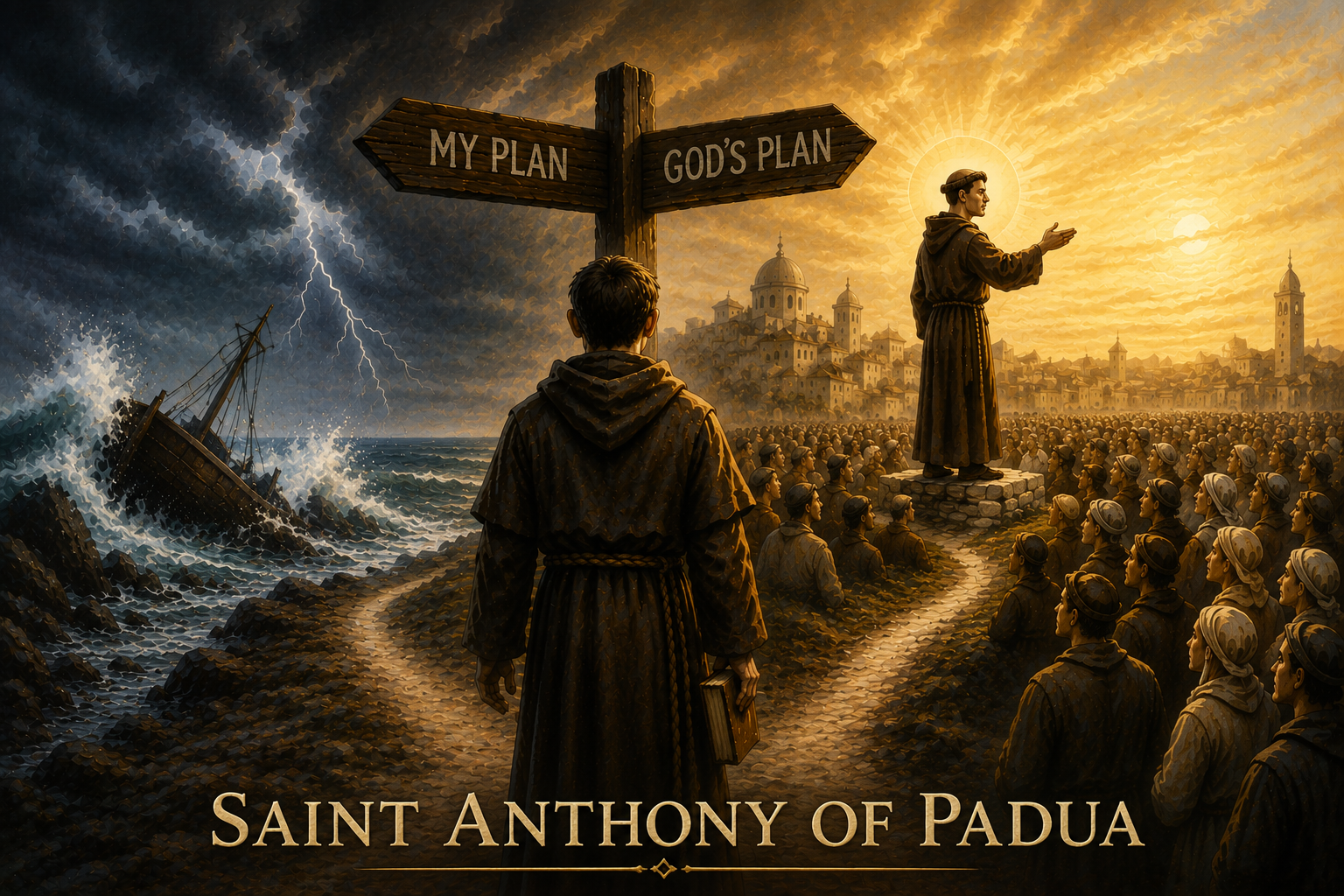
Anthony immediately sailed for Morocco, determined to preach Christ and, if necessary, die as a martyr. But God had other plans.
Shortly after arriving, Anthony became gravely ill and was forced to return to Europe. During the voyage, a violent storm drove his ship hundreds of miles off course to Sicily.
From there, he eventually settled in the secluded hermitage of Montepaolo near Forlì in northern Italy. For nearly a year, he lived in obscurity performing humble tasks, praying, and studying.
His dream appeared to be over. The Moment That Changed Everything. At an ordination of Dominican and Franciscan friars in Forlì, the scheduled preacher unexpectedly failed to arrive.
Someone turned to the quiet young friar and simply asked, “Can you say a few words?”
Anthony accepted.
His passion. His clarity. His humility. His extraordinary knowledge of Scripture left the audience speechless.
Word spread rapidly.
Within months, Anthony had become one of the greatest preachers in Europe.
Why Was He So Effective?
Anthony possessed a rare gift: he could communicate profound theological truths in ways ordinary people could understand and remember.
In today’s terms, he wasn’t just a theologian but a master communicator. He used everyday experiences, vivid imagery, practical examples, and deep biblical knowledge to connect with people. Thousands came to hear him preach.
Anthony was canonized less than one year after his death at the age of 35. THis was one of the fastest canonizations in Church history reflecting his extraordinary reputation for holiness and the many miracles attributed to his intercession.
In 1946, he was declared a “Doctor of the Church” and became known as the “Evangelical Doctor” because of his extraordinary preaching and explanation of the Gospel.
Saint Anthony teaches us taht smetimes your greatest calling begins when your original plan fails. This lesson resonates with CEOs, military leaders, parents, and anyone whose life hasn’t unfolded as expected.Failure Isn’t Final — His dream of becoming a missionary martyr never happened.
Modern Leadership Lessons
- Preparation Matters — Years of quiet study prepared him for the opportunity he never expected.
- Stay Faithful in Small Things — Before preaching to thousands, he faithfully washed dishes.
- Opportunity Often Arrives Unexpectedly — His life changed because someone simply asked, “Can you say a few words?”
- God’s Plan Is Often Better Than Ours — Anthony lost the future he imagined but discovered the future God intended.
- Great leaders don’t simply know the truth—they know how to communicate it in a way that inspires others to understand it, believe it, and act upon it.
Nearly 800 years after his death, Saint Anthony remains a timeless reminder that influence is earned not only through knowledge, but through humility, clarity, conviction, and faithful service.
Anthony understood something modern communicators often forget: People remember stories—not lectures.