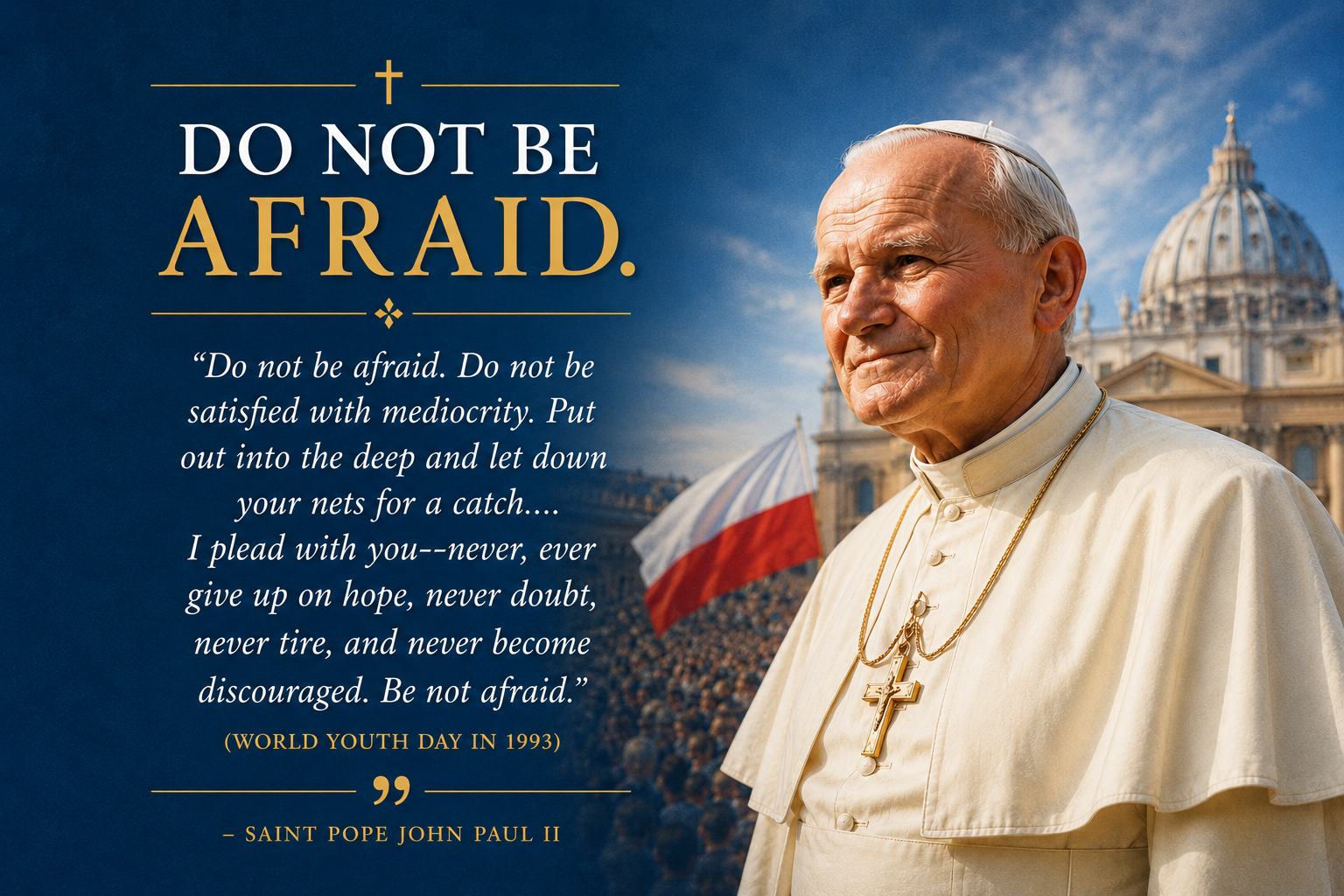
Today we celebrate the birthday of Pope John Paul II, one of the most consequential figures of the twentieth century.
Born Karol Józef Wojtyła on May 18, 1920, in Wadowice, he lived through some of history’s darkest chapters. He survived Nazi occupation, witnessed the destruction of his homeland during World War II, and later endured Soviet communist domination over Poland and Eastern Europe.
To understand Saint Pope John Paul II, you must understand the Cold War — the decades-long ideological struggle between the free world and the Soviet communist bloc. During much of this period, Poland existed under Soviet control as part of the Warsaw Pact, where citizens faced censorship, political repression, economic hardship, and restrictions on religious freedom.
John Paul II understood firsthand the dangers of totalitarianism, Marxism, and atheistic government power. Because he lived under both Nazism and Communism, he became one of the world’s strongest defenders of religious liberty, human dignity, national sovereignty, and moral truth.
On October 16, 1978, he became the first non-Italian pope in 455 years.
Then came the moment that changed history. During his historic 1979 visit to Poland, millions gathered to hear him proclaim:
“Do not be afraid.” Those words awakened a nation. His spiritual leadership helped inspire the Solidarity movement led by Lech Walesa and contributed to the peaceful collapse of communist rule in Poland in 1989. After gaining freedom from Soviet control, Poland transitioned into a democratically elected constitutional republic built on political freedom, free elections, individual liberties, and a market-based economy.
JP2 warned that socialism misunderstands the human person by subordinating individual dignity and freedom to the collective or state.
“The fundamental error of socialism is anthropological in nature.” — Pope John Paul II
John Paul II was not simply anti-communist. He also warned against consumerism, moral relativism, and societies that abandoned truth and faith. His vision was rooted in Christian human dignity, not class warfare or political revolution.
I believe Saint Pope John Paul II offers an important contrast to certain modern movements within the Church that place greater emphasis on social and economic theories influenced by Liberation Theology. Having witnessed firsthand the devastation caused by Marxist ideology, JP2 consistently warned against reducing Christianity to political activism or collectivist ideology. He stated: “The Church’s concern for the poor… must not be confused with ideological systems which seek to reduce the Gospel to a purely earthly project.”
Today, some Catholic leaders appear to move dangerously close to what Cardinal Ratzinger (later Pope Benedict XVI) cautioned against as becoming “captive to ideology.”
“Marxist analysis carries within itself ideological presuppositions incompatible with the Christian vision of man.” — Benedict XVI
His legacy extended far beyond politics.
He founded World Youth Day, inspiring millions of young Catholics worldwide. He developed the Theology of the Body, offering profound teachings on marriage, sexuality, love, and human identity.
One of Pope John Paul II’s most influential teachings was the Theology of the Body, a series of reflections on human dignity, identity, love, sexuality, and the meaning of the human person. At its core, JP2 taught that every person is intentionally created by God with inherent value and purpose — body and soul together.
In a culture where many people struggle with self-worth, isolation, identity confusion, or dissatisfaction with their bodies, Theology of the Body offers a radically different message: your worth is not determined by cultural trends, social approval, or personal feelings alone, but by the fact that you were created in the image of God. John Paul II believed the human body is not a mistake to be rejected but a gift that reveals the truth about who we are, our capacity to love, and our call to live with dignity, compassion, and purpose.
“Your dignity is not based on your sexuality, your feelings, or your past. Your dignity comes from the fact that you are made in the image and likeness of God.” — Jason Evert
He traveled to more than 120 countries, survived an assassination attempt in 1981 and forgave his attacker, defended the sanctity of life and the family, and became one of the most recognizable spiritual leaders of modern history.
- A saint.
- A survivor.
- A spiritual warrior who lived through Nazism, Communism, war, tyranny, revolution, an assassination attempt, and yet never lost hope.
“Be not afraid.” — Saint Pope John Paul II