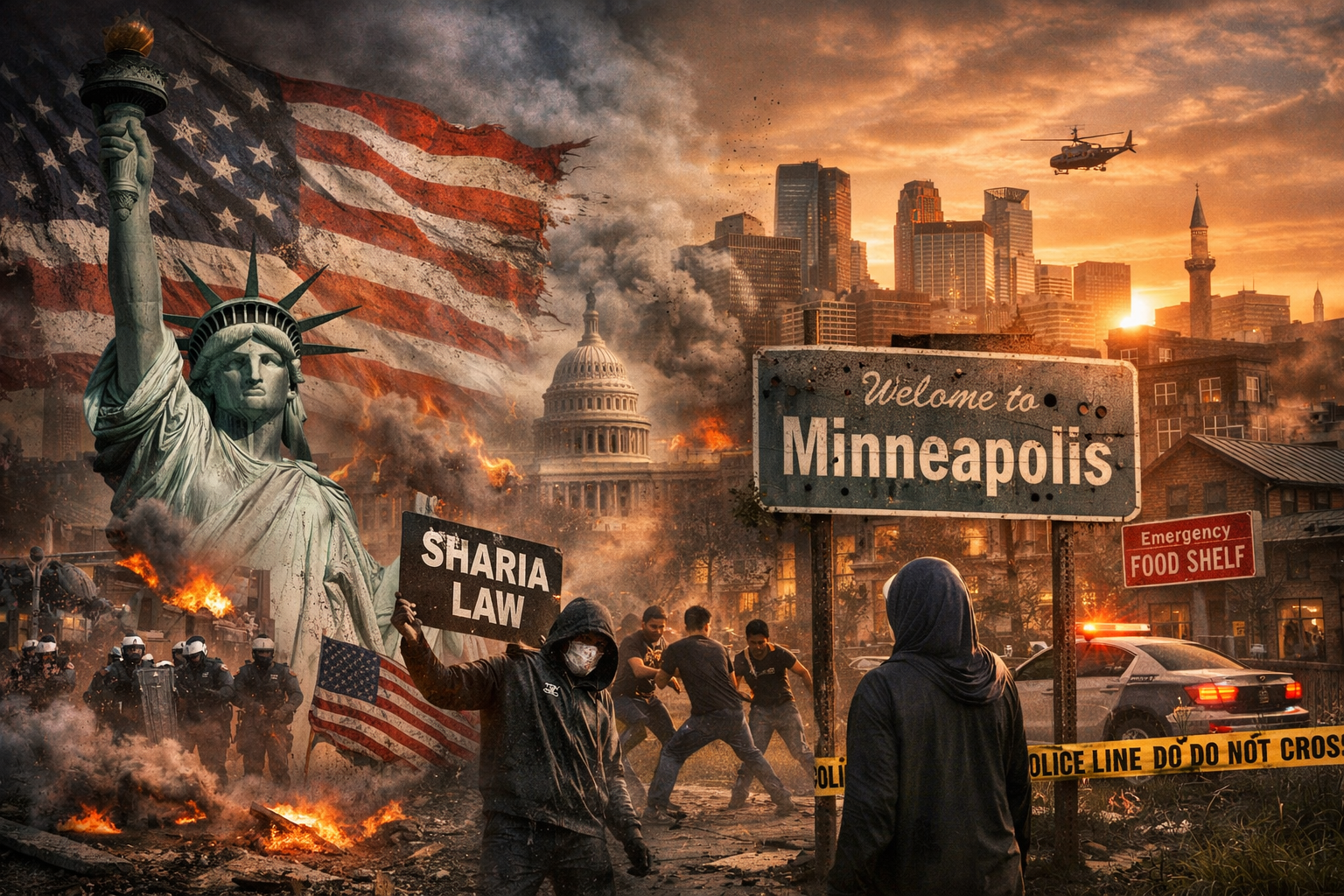
Introduction: A Failure of Judgment, Not of Compassion
Every nation has the right—and the obligation—to decide who it admits and on what terms. That responsibility shapes cultural cohesion, legal stability, and a country’s future inheritance.
Americans should be deeply troubled by the long-running decision of federal, state, and local leaders to permit large-scale immigration and refugee resettlement from Somalia, particularly into concentrated regions such as Minneapolis–Saint Paul. This is not a rejection of human dignity or compassion. It is a critique of policy judgment.
If policymakers were asked to identify the least compatible source country for mass migration into a constitutional republic founded on individual rights, the rule of law, and civic assimilation, Somalia would rank near the top.
This outcome was not inevitable. It was a choice—and a profoundly flawed one.
Intergenerational Stewardship and National Responsibility
A nation is more than a refuge; it is a civilizational trust. Americans have long understood the idea of intergenerational responsibility—that we are stewards of a country we did not create and must preserve for those who come after us. Native traditions describe this as Seventh Generation thinking: act today with the welfare of your grandchildren’s grandchildren in mind.
By that standard, mass immigration from societies structurally opposed to America’s legal and constitutional foundations is indefensible.
Compassion for individuals does not require recklessness in policy. Personal kindness and national decision-making are not the same thing.
Somalia in Context: Size, Population, and Stability
Somalia is not a small or marginal state.
- Land area: ~637,000 km² — roughly the size of Texas
- Population: ~18–19 million — comparable to New York State
Somalia has lacked a stable central government since 1991. It consistently ranks among the least stable and most corrupt countries in the world, marked by fragmented authority, endemic corruption, weak institutions, and ongoing violence from armed groups including al-Shabaab.
These conditions are structural, not temporary.
Socioeconomic Conditions and Human Development
Somalia’s social indicators rank among the lowest globally:
- Poverty: Over half the population lives below the national poverty line
- Literacy: ~37–40% adult literacy
- Men: ~45–50%
- Women: ~25–30%
- Men: ~45–50%
- Average schooling: ~2.5 years
- Life expectancy: ~59 years
Health burdens include high rates of tuberculosis, chronic malnutrition among children, elevated maternal mortality, endemic hepatitis B, and widespread untreated mental-health trauma from decades of war and displacement.
These realities profoundly affect integration outcomes in host countries.
Why Mass Immigration from Muslim-Majority Societies Conflicts with America’s Constitutional Order
The central issue is not race, ethnicity, or personal worth.
It is law, governance, and allegiance to incompatible legal authority.
Somalia is a near-homogeneous Muslim society—over 99% of the population identifies as Muslim, overwhelmingly Sunni. Somalia’s provisional constitution declares Islam the state religion and mandates that no law may contradict Sharia. This is not symbolic; it is foundational.
Sharia law is not an individual-rights-based system. It is a communal, duty-based legal framework rooted in divine authority rather than popular sovereignty. Rights are conditional, subordinate to religious obligation and communal order, and historically applied unequally based on religion, gender, and conformity to prescribed norms.
This stands in direct opposition to the American system, which is grounded in:
- Natural rights that exist prior to government
- Individual liberty
- Equality before the law
- Freedom of conscience
- Separation of religion and state
Public opinion data underscores the divide. Research including a widely cited Voice of America survey found that approximately 85% of Somalis favor Sharia law as the governing framework for civil and criminal matters. That preference may be coherent within Somalia’s context—but it is irreconcilable with American constitutional governance.
Mass immigration from societies where a large majority affirm religious law over secular constitutional law predictably creates tension:
- Conflicting legal expectations
- Resistance to full civic assimilation
- Parallel social and moral norms
- Pressure on free speech, religious liberty, and equal protection
This is not an argument against treating individuals with dignity. It is an argument against reckless policy that ignores civilizational reality.
Somali Immigration to the United States: Policy Choices by Administration
While no single public table aggregates Somali admissions neatly by presidency, cumulative trends are clear:
- Total Somali-born population in the U.S.: ~98,000
- People of Somali descent (including U.S.-born): ~260,000
- Somali refugees resettled since 2001: ~110,000+
By administration (approximate trends):
- George W. Bush (2001–2009): Continued refugee resettlement following the 1990s state collapse.
- Barack Obama (2009–2017): Expanded refugee admissions; tens of thousands of Somali refugees admitted.
- Donald Trump (2017–2021): Sharply reduced refugee ceilings and increased screening, slowing—but not reversing—prior trends.
- Joe Biden (2021–2025): Reversed restrictions early in 2021, reopened refugee channels, renewed TPS, and oversaw historically higher overall refugee ceilings.
Minnesota and the Twin Cities: A Concentration with Consequences
Minnesota is now home to the largest Somali diaspora in the United States.
- Minnesota (statewide): ~100,000–107,000 people of Somali descent
- Minneapolis–Saint Paul metro: ~84,000 people of Somali descent
- City of Minneapolis: ~33,500 people of Somali descent
This concentration did not occur organically; it was policy-driven through refugee placement and secondary migration.
Recent corruption investigations, governance failures, and social-services scandals in the Twin Cities did not arise in a vacuum. They reflect predictable stress created when rapid demographic change outpaces integration capacity and civic cohesion—compounded by weak leadership unwilling to acknowledge tradeoffs.
Conclusion: Policy, Not Prejudice
America can—and should—treat every person with dignity. But a nation that abandons discernment in immigration policy abandons its future.
We must distinguish:
- Personal moral responsibility → kindness to neighbors
- Public policy responsibility → protecting constitutional order
Mass immigration from Somalia failed that test. The consequences were foreseeable, the warnings were available, and the costs are now borne locally—especially in places like Minneapolis–Saint Paul.
If we care about the country we leave to our grandchildren and their grandchildren, we must have the courage to say:
Some decisions—however well-intended—should never have been made.
References
Council on Foreign Relations. Al-Shabab in Somalia. Council on Foreign Relations,
www.cfr.org/backgrounder/al-shabab.
FactCheck.org. Meme Misleads on Minnesota’s Somali Refugees. 4 Feb. 2019,
www.factcheck.org/2019/02/meme-misleads-on-minnesotas-somali-refugees/.
Federal Register. Executive Order 14010: Creating a Comprehensive Regional Framework to Address the Causes of Migration. 5 Feb. 2021,
www.federalregister.gov/documents/2021/02/05/2021-02561.
Federal Register. Executive Order 14012: Restoring Faith in Our Legal Immigration Systems and Strengthening Integration and Inclusion Efforts for New Americans. 5 Feb. 2021,
www.federalregister.gov/documents/2021/02/05/2021-02563.
Fox 9 Minneapolis–St. Paul. How Many Somalis Live in Minneapolis? Dec. 2025,
www.fox9.com/news/how-many-somalis-live-minneapolis-dec-2025.
Migration Policy Institute. Refugees and Asylees in the United States. Migration Policy Institute,
www.migrationpolicy.org/topics/refugees-and-asylees.
Minnesota Reformer. Most Somali People in America and Minnesota Are Citizens. Minnesota Reformer,
minnesotareformer.com/briefs/most-somali-people-in-america-and-minnesota-are-citizens/.
Oxford Islamic Studies Online. Sharia. Oxford University Press,
www.oxfordislamicstudies.com/article/opr/t125/e2189.
Pew Research Center. The World’s Muslims: Religion, Politics and Society. Pew Research Center, 30 Apr. 2013,
www.pewresearch.org/religion/2013/04/30/the-worlds-muslims-religion-politics-society/.
Public Broadcasting Service (PBS). Five Things to Know About the Somali Community in Minnesota. PBS NewsHour,
www.pbs.org/newshour/nation/5-things-to-know-about-the-somali-community-in-minnesota.
Reuters. U.S. Ends Temporary Protected Status for Thousands of Somalis. 13 Jan. 2026,
www.reuters.com/world/us/us-ends-temporary-protected-status-thousands-somalis-us-fox-news-reports-2026-01-13/.
Somalia. Provisional Constitution of the Federal Republic of Somalia. 2012,
www.constituteproject.org/constitution/Somalia_2012.pdf.
Transparency International. Corruption Perceptions Index 2024: Somalia. Transparency International,
www.transparency.org/en/cpi/2024.
UNESCO Institute for Statistics. Somalia: Education and Literacy Data. UNESCO,
uis.unesco.org/en/country/so.
UNAIDS. Somalia Country Fact Sheet. Joint United Nations Programme on HIV/AIDS,
www.unaids.org/en/regionscountries/countries/somalia.
United Nations Children’s Fund (UNICEF). Somalia: Education and Child Welfare. UNICEF,
www.unicef.org/somalia.
United Nations Development Programme. Human Development Report: Somalia. UNDP,
hdr.undp.org/en/countries/profiles/SOM.
United States Census Bureau. American Community Survey (ACS). U.S. Department of Commerce,
www.census.gov/programs-surveys/acs.
United States Department of Homeland Security. Yearbook of Immigration Statistics. DHS Office of Immigration Statistics,
www.dhs.gov/immigration-statistics/yearbook.
United States Department of State. 2022 Country Reports on Human Rights Practices: Somalia. U.S. Department of State,
www.state.gov/reports/2022-country-reports-on-human-rights-practices/somalia/.
United States Department of State. Refugee Admissions and Arrivals. Refugee Processing Center,
www.rpc.state.gov/admissions-and-arrivals/.
World Bank. Somalia Overview. World Bank Group,
www.worldbank.org/en/country/somalia/overview.
World Health Organization. Somalia Country Profile. WHO,
www.who.int/countries/som.