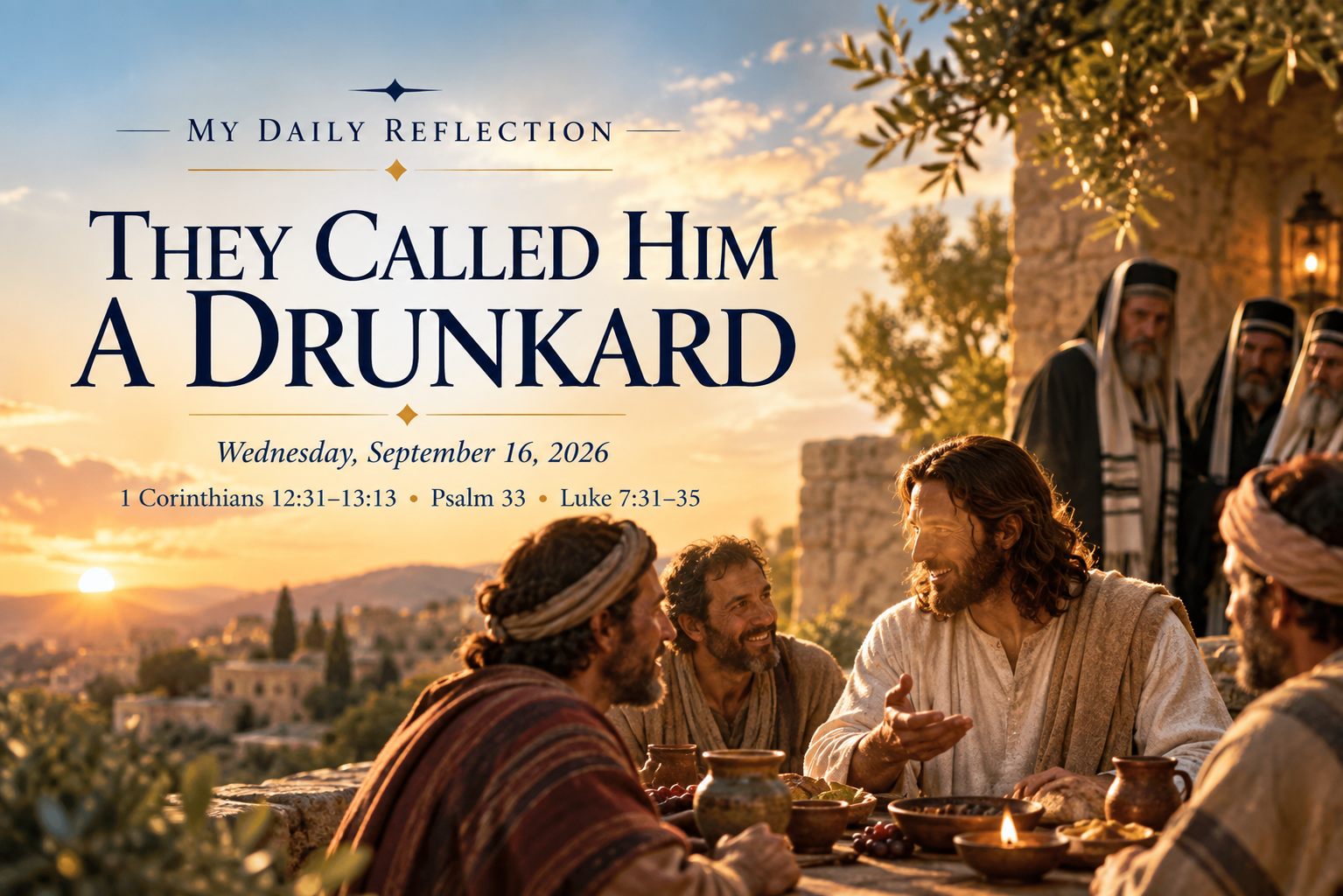
My Daily Reflection
September 16, 2026
1 Corinthians 12:31–13:13 • Psalm 33 • Luke 7:31–35
Imagine hearing people say this about Jesus:
“Look at him, he is a glutton and a drunkard, a friend of tax collectors and sinners.”
That line from today’s Gospel stopped me in my tracks.
Jesus was doing exactly what the Father had sent Him to do. He healed the sick, forgave sinners, proclaimed the Kingdom of God, and sought out those whom respectable society often ignored or rejected.
Yet people attacked His character.
John the Baptist lived a life of fasting and sacrifice, and they said he had a demon.
Jesus shared meals with ordinary people, including tax collectors and sinners, and they called Him a glutton and a drunkard.
Neither man could satisfy his critics.
And maybe that is part of the lesson.
Faithfulness Over Approval
Jesus loved people deeply. He loved them enough to die for them.
But He did not allow public opinion to define His mission.
He knew who He was.
He knew who had sent Him.
And He knew what the Father was asking Him to do.
That certainty gave Him a freedom many of us lack today.
If Jesus had measured His faithfulness by public approval, He would have abandoned His mission. Instead, He measured His life by obedience to the Father.
That distinction is as important today as it was two thousand years ago.
Jesus cared deeply about people, but He did not live for their approval.
The Crowd Will Always Find Fault
The Gospel reveals something timeless about human nature.
John fasted.
Too extreme.
Jesus ate with sinners.
Too worldly.
John lived an austere life.
He has a demon.
Jesus entered people’s homes and shared their lives.
Look at the company He keeps.
The problem was not that John and Jesus had chosen the wrong approach. The deeper problem was an unwillingness to recognize God at work.
Sometimes criticism contains something we need to hear. Humility requires us to listen, examine ourselves, and correct our mistakes.
But criticism is not automatically truth.
Jesus reminds us that faithfulness to God will sometimes be misunderstood and even misrepresented.
The question cannot always be:
“What will people think of me?”
The better question is:
“Am I doing what God is asking of me?”
A Friend of Sinners
Ironically, one of their insults revealed something beautiful about Jesus.
He truly was a friend of sinners.
He went where broken people were.
He spoke with them.
He loved them.
He forgave them.
And He called them to conversion.
Jesus was not concerned that extending mercy might damage His reputation among those who considered themselves righteous. He came to seek and save the lost.
That was the Father’s will.
And He was not about to abandon His mission because others misunderstood it.
What This Means for Us
Jesus told His disciples:
“Because you do not belong to the world, and I have chosen you out of the world, the world hates you.” (John 15:19)
That does not give us permission to be arrogant, harsh, or dismissive of others. In fact, today’s first reading tells us exactly the opposite:
Love is patient. Love is kind.
One of the central themes of my upcoming book, Faithful Participation in Public Life, is that faithful citizenship begins with faithful discipleship. Before we can influence the culture, we must first decide whom we will follow.
As Christians, we should not be surprised when obedience to Christ brings criticism.
When we defend the dignity of unborn children, uphold traditional marriage, oppose euthanasia, or proclaim other difficult moral teachings of our faith, some people will strongly disagree with us and may question our motives.
Our response cannot be anger or contempt.
It must be truth spoken with love.
Jesus was called a glutton, a drunkard, and a friend of sinners.
Yet He kept walking.
He kept loving.
He kept serving.
And He kept doing the Father’s will.
The goal of the Christian life is not popularity.
The goal is faithfulness.
We should listen to criticism with humility. When we are wrong, we should repent and change.
But we must never confuse approval with faithfulness.
If, after prayer and honest discernment, we believe God is calling us to act, speak, serve, or witness in a particular way, then we need the courage to do so—even when our motives are questioned or our character is attacked.
Perhaps discipleship means learning to do what Jesus did:
Love people deeply. Listen humbly. And keep doing the Father’s will.
Today’s Question
Am I trying harder to win the approval of the crowd, or to be faithful to the Father?
A special thank you to Fr. Greg Olszewski for his homily at this morning’s Mass, which inspired today’s reflection.