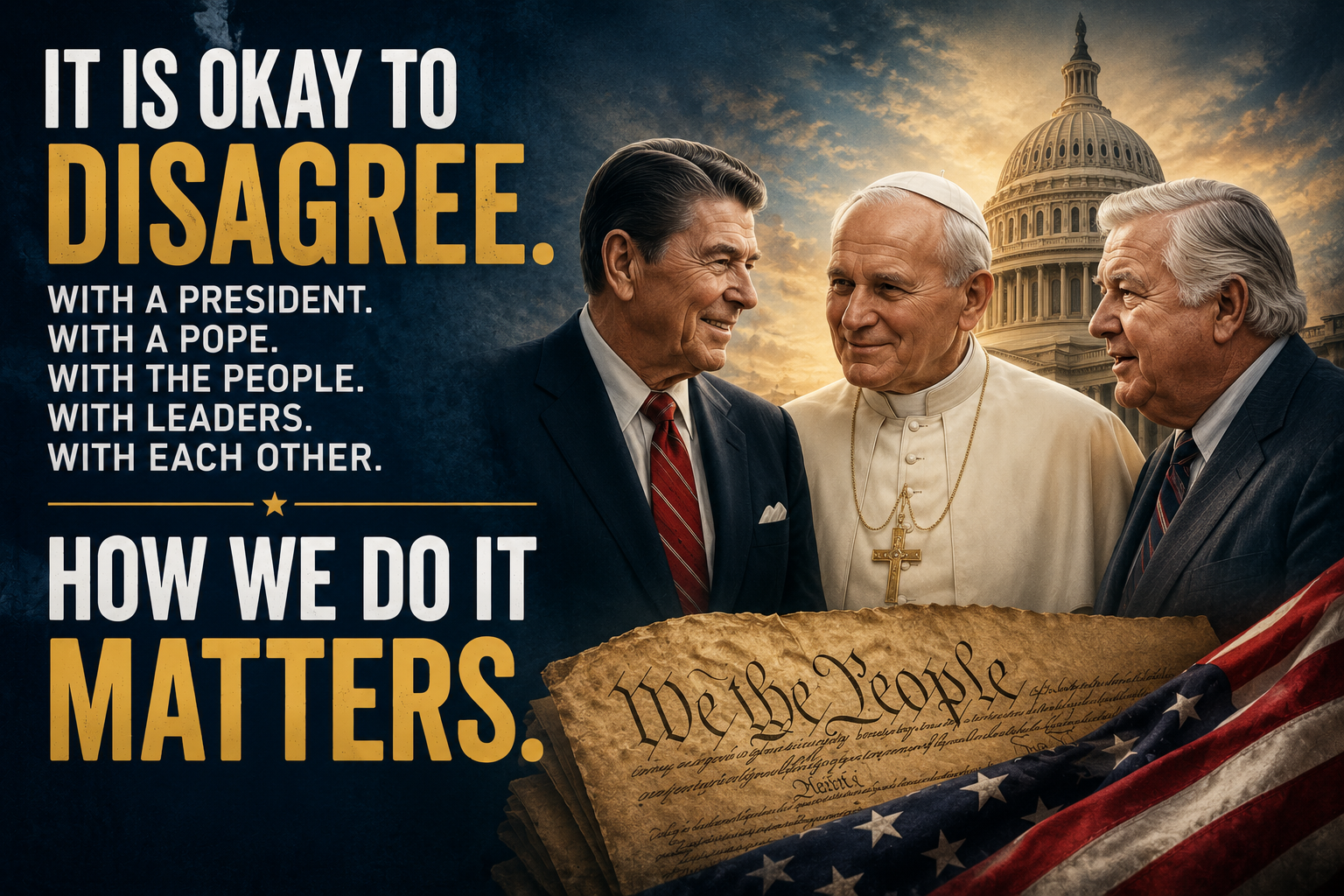
Why have we lost the ability to disagree respectfully? The decline of respectful disagreement in the United States didn’t occur suddenly. Most historians and political analysts see it as a gradual deterioration that sped up over many decades, particularly from the late 1960s onward.
The Cultural Upheaval
One major factor that accelerated the loss of social decorum was the cultural upheaval of the 1960s and 1970s. This included the civil rights struggles, the Vietnam War, the Watergate scandal, the modern feminist movement, political assassinations, campus unrest, and growing distrust of institutions. America experienced a tremendous amount of social change within a relatively short period of time. Before this era, Americans generally shared agreement on many core assumptions such as patriotism, civic identity, religious morality, trust in institutions, and common media sources through a small number of major television networks and newspapers.
Over time, suspicion increasingly shifted toward many of society’s institutions, including government, media, universities, churches, and corporations. People’s understanding of the world no longer rested on a shared cultural foundation.
America began to change when we stopped believing our political opponents were simply mistaken and started believing they were dangerous. A republic cannot endure when disagreement turns into dehumanization, when contempt replaces civility, and when fellow citizens become enemies rather than Americans with differing convictions.
The Collapse of Shared Moral Foundations
For most of American history, even non-religious Americans operated within a broadly Judeo-Christian moral framework grounded in objective truth, duty, restraint, forgiveness, dignity, and civic virtue.
As secularization accelerated in the late twentieth century, Americans increasingly lost consensus on truth itself, the meaning of freedom, what constitutes justice, and even what it means to be a human person. Once a society loses shared moral reference points, political and cultural disagreements stop feeling like ordinary policy debates and begin to feel like battles over identity, survival, and the future of civilization itself.
Technology and the Age of Outrage
The transformation of American society was accelerated by rapid technological change — from the rise of the internet and smartphones to social media and algorithm-driven news feeds. What began in the flip-phone era as a tool for connection evolved into a digital ecosystem increasingly designed to capture attention, amplify emotion, and maximize engagement.
The rise of partisan cable media in the 1990s and social media in the 2000s fundamentally reshaped the incentives of public discourse. Anger became profitable. Nuance and thoughtful debate struggled to compete with outrage, tribalism, fear, humiliation, and moral absolutism. Artificial intelligence-driven algorithms increasingly pushed people beyond the stabilizing influence of family, churches, local communities, and friendships into ideological ecosystems that reinforced identity, suspicion, and division.
Social media gave everyone a voice. Algorithms taught many to use it without wisdom, restraint, or charity.
When Politics Became Identity
Historically, most Americans viewed politics as important but ultimately secondary to deeper sources of identity, such as faith, family, marriage, community, and nation. As traditional institutions weakened, many people increasingly sought identity, belonging, moral purpose, and meaning elsewhere. For many, politics filled that vacuum.
Political movements and ideological tribes became more than policy preferences; they became personal identities. Individuals increasingly defined themselves not only by what they believed but also by which side they were on and which causes they opposed. Once politics becomes intertwined with personal identity, disagreement no longer feels like a debate over ideas; it feels like a personal attack on one’s dignity, values, and worldview.
Compromise begins to feel like betrayal. Opponents increasingly appear dangerous rather than mistaken. Political debates become emotionally totalizing.
A republic survives when citizens can disagree passionately while still respecting one another’s humanity.
The Crisis of Institutional Trust
Confidence in America’s institutions has steadily eroded over recent decades. Trust has declined not only in Congress and the media, but also in universities, corporations, churches, public health agencies, and even the integrity of elections themselves.
As trust weakens, suspicion naturally grows. Citizens increasingly assume hidden motives, corruption, manipulation, ideological agendas, or bad faith behind major decisions and public narratives. Drawing on themes throughout Vote Your Core, the deeper crisis is not merely political but moral and spiritual. A constitutional republic depends on shared truth, civic virtue, and confidence that institutions at least attempt to serve the common good. When truth becomes fragmented and institutions appear detached from moral foundations, society becomes vulnerable to cynicism, tribalism, and division.
The Loss of Moral Middle Ground
America has never been a perfectly peaceful or unified nation. Its history includes the Civil War, violent labor clashes, segregation, riots, fierce religious disputes, and deeply partisan newspapers dating back to the nineteenth century. Conflict is not new to the American experience.
What is different today is the scale, speed, and intensity with which division spreads through modern society. Technology, social media, algorithm-driven outrage, and twenty-four-hour political media create a constant cycle of emotional reinforcement that nationalizes every controversy and magnifies every disagreement.
At the same time, America has seen the erosion of a shared moral language rooted in faith, civic virtue, and common cultural assumptions. Increasingly, the nation no longer debates merely solutions or policies; it debates truth, identity, and reality itself.
Several modern thinkers warned that this collapse would eventually turn politics into a substitute religion. G. K. Chesterton warned that when societies abandon transcendent truth, opponents are viewed as heretics, compromise is seen as moral surrender, and political power becomes ultimate. Many observers believe modern America increasingly reflects that pattern.
The ability to disagree respectfully survives only when a society still shares deeper commitments: belief in human dignity, limits on power, civic virtue, and loyalty to truth over tribal identity. Without those foundations, politics gradually shifts from civic debate to cultural warfare.
What Can We Do?
Modern America desperately needs the revival of honorable disagreement. A constitutional republic cannot survive when every political disagreement becomes personal hatred, every debate becomes tribal warfare, and every opponent becomes an enemy to destroy rather than a fellow citizen to persuade.
Christians, in particular, are called to something higher. We are commanded not only to defend truth but to defend it rightly—with clarity, humility, charity, prudence, and moral courage.
Restoring civility does not mean abandoning conviction or pretending that truth no longer matters. It means learning once again how to disagree without contempt.
Distinguish the Office from the Person
Citizens may respect the presidency while opposing its policies. Catholics may honor the papacy while questioning prudential statements or decisions. When disagreement shifts from evaluating ideas and actions to humiliating or destroying individuals, public discourse quickly collapses into resentment and hatred.
A mature republic requires citizens capable of criticizing policies without degrading human dignity.
Focus on Principles, Not Motives
Modern discourse increasingly collapses because people presume to know others’ hearts. Accusations such as “They hate America,” “They hate Christianity,” or “They are evil” rarely produce clarity or persuasion.
Mature disagreement focuses instead on actions, policies, consequences, contradictions, evidence, and truth claims. This keeps criticism grounded in reason rather than emotion or suspicion.
A mature citizen can oppose another man’s ideas without denying his dignity.
Recover Humility
Even leaders we strongly oppose may believe they are acting in the public good, may have incomplete information, or may face pressures the public cannot fully see. Recognizing complexity does not weaken conviction; it strengthens credibility.
Human beings are rarely as simple as political tribes portray them.
Use Moral Language Carefully
Christ Himself strongly rebuked hypocrisy and courageously defended the truth. But Christian tradition also warns against rash judgment, slander, contempt, calumny, and hatred.
A loyal citizen aims to enlighten, persuade, uphold the truth, and caution against mistakes—not to humiliate or destroy others. The purpose of public discussion should be to foster understanding and clarity, rather than to seek revenge or shame.
Anchor Arguments in Objective Truth
Disagreement must be grounded in objective standards rather than emotion alone. Christians should evaluate policies and leaders by Scripture, constitutional principles, Church teaching, natural law, evidence, history, and reasoned judgment.
Saying, “I disagree with this policy because it conflicts with the dignity of human life,” is fundamentally different from launching personal attacks. One appeals to truth; the other appeals to emotion and tribalism.
“The further a society drifts from the truth, the more it will hate those who speak it.” — George Orwell
Preserve Charity While Maintaining Conviction
Charity does not require surrendering the truth, but it does require remembering that every person possesses God-given dignity. Saint Thomas Aquinas taught that correction should aim at truth, justice, and the good of souls—not at pride, rage, or vengeance.
In a society increasingly addicted to outrage, Christians are called to model disciplined speech and moral restraint.
True strength is not found in humiliating opponents, but in defending conviction without losing charity.
Resist Tribalism
A healthy republic allows loyalty without idolatry, criticism without revolution, and unity without uniformity. Disagreement is not betrayal.
Citizens can disagree deeply while still loving their country, respecting institutions, and recognizing their opponents’ humanity. That balance once formed the moral center of American civic life, and its restoration is essential if the nation hopes to regain stability and trust.
Respectful disagreement is not weakness. It is the discipline of placing truth above ego and country above tribe.
A Practical Approach to Respectful Disagreement
A practical approach to respectful disagreement is simple:
• acknowledge the office or role
• state the disagreement clearly
• explain the reasons using evidence and principle
• avoid attacking motives or dignity
• remember that two wrongs never make a right
• articulate the desired good outcome
This approach does not weaken truth. It strengthens it. Civilization depends not merely on freedom of speech but on the virtue and discipline with which speech is exercised.
The future of the republic may well depend on whether Americans can once again learn to disagree with honor.
What Our Faith Teaches About Disagreement
One of the great confusions in modern Catholic discourse is the misunderstanding of authority, obedience, and respectful disagreement. Many Catholics mistakenly assume that fidelity requires agreement with every statement, interview, political opinion, or prudential judgment made by a pope or Church leader. Others move to the opposite extreme, treating disagreement as a justification for contempt, rebellion, or rejection of legitimate authority.
The Catholic tradition teaches neither blind servility nor rebellious individualism. Instead, it teaches faithful obedience rooted in truth, charity, prudence, and humility.
Infallibility vs. Prudential Judgment
The Church has always distinguished between infallible teachings on faith and morals and prudential judgments in politics, economics, diplomacy, strategy, or administration. This distinction is essential to healthy Catholic citizenship and mature public discourse.
Papal infallibility is exercised very rarely. Over the past 150 years, it is generally understood to have been formally invoked only twice through ex cathedra declarations: the dogma of the Immaculate Conception, proclaimed by Pope Pius IX in 1854, and the Assumption of Mary, proclaimed by Pope Pius XII in 1950.
These extraordinary teachings address definitive matters of faith and morals binding on the faithful. Most papal comments, interviews, pastoral emphases, policy preferences, and prudential observations do not fall into that category.
Understanding this distinction allows Catholics to remain faithful to the Church while respectfully disagreeing on prudential matters.
Faithful Disagreement in Church History
The Church’s history offers many examples of honorable disagreement rooted in fidelity rather than rebellion. Saint Paul publicly corrected Saint Peter on conduct toward Gentile Christians. Saint Catherine of Siena urged Pope Gregory XI to return to Rome during a crisis. Saint Thomas More opposed King Henry VIII while remaining faithful to conscience and truth.
These examples remind us that fidelity does not require silence in the face of confusion or error. Correction must remain ordered toward truth, unity, and charity.
Conviction Without Contempt
Catholic teaching consistently warns against letting disagreement descend into contempt, rash judgment, slander, or hatred. Christians are called to speak the truth courageously while preserving the dignity of the person they oppose.
As many Catholic thinkers put it: “Be neither cowardly nor contemptuous.”
We are not permitted to abandon the truth out of fear, nor to lose charity in defending it.
Respectful disagreement requires discipline. It means criticizing actions and ideas rather than presuming motives or attacking character. It means grounding arguments in Scripture, reason, natural law, constitutional principles, evidence, and Church teaching rather than in emotion or tribal anger.
The goal of Christian discourse is not domination, but truth ordered toward the common good.
Humility is the ability to defend truth fiercely without forgetting the dignity of the person standing across from you.
And remember, returning to an age where we can disagree respectfully starts with me and you.