Why Is He Important to Us Today?
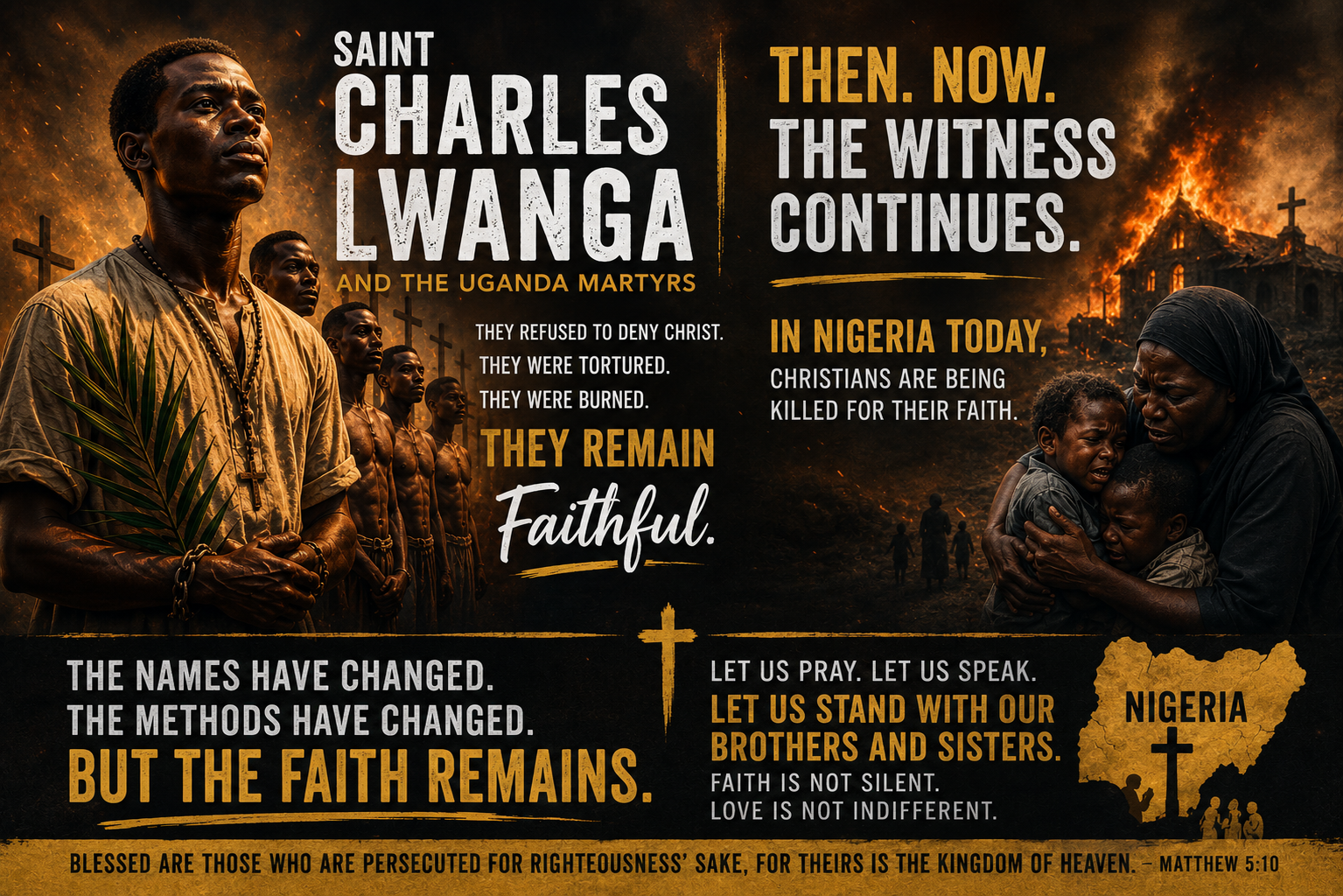
Charles protected younger Christian converts from the immoral demands of King Mwanga II of Buganda (modern-day Uganda) and encouraged them to remain faithful to Christ. He refused to allow fear, power, or coercion to separate them from their faith. When ordered to abandon Christianity, Charles refused. So did many of the young men he led.
The king increasingly viewed Christianity as a threat to his authority and demanded absolute obedience from the young men serving in his court. Charles became a leader among the Christian pages and catechists, helping instruct converts in the faith and encouraging them to remain faithful despite mounting persecution.
On June 3, 1886, Charles Lwanga and many of his companions were executed at Namugongo. Several were burned alive. According to accounts preserved by the Church, even while being tortured and offered freedom in exchange for renouncing Christ, Charles refused.
One tradition records his response:
“You are burning me, but it is as if you are pouring water over my body.”
He died praying.
Today, Christians are being persecuted and dying for their faith in places such as Nigeria, Sudan, the Democratic Republic of Congo, and elsewhere in Africa.
Nigeria has become the modern epicenter of Christian persecution. Islamist extremist groups, including Boko Haram (an Islamic terrorist organization) and Islamic State West Africa Province (ISWAP), have targeted churches, priests, pastors, and Christian villages for years, leaving thousands dead and countless others displaced.
According to Vatican reporting and international religious freedom organizations, more Christians are killed for their faith in Nigeria than in any other country in the world. The witness of these believers echoes that of Saint Charles Lwanga and the early martyrs, reminding us that for many Christians today, openly professing faith in Christ still carries the risk of imprisonment, violence, or death.
Our brothers and sisters who are being persecuted and killed for their faith have Saint Charles Lwanga as the patron saint of African youth, converts, Catholic Action, and torture victims. A patron saint is a saint whom the Catholic Church recognizes as a special heavenly advocate, protector, or intercessor. Catholics ask saints to pray for them before God, much like asking a trusted friend to pray for you.
Following the death of Saint Charles Lwanga and the Uganda Martyrs in 1886, Namugongo became a symbol of Christian courage in the face of persecution. Every year on June 3, hundreds of thousands—and sometimes more than a million—pilgrims travel to Namugongo from across Africa. Many walk for days or even weeks to honor the martyrs and pray for the same courage that Charles and his companions demonstrated when they chose faithfulness to Christ over safety, comfort, and even life itself.
For many pilgrims, their witness is not merely history—it is a reminder that Christians in parts of Africa still face violence, discrimination, and persecution for their faith today.
Saint Charles Lwanga and the Uganda Martyrs are a stark reminder of the cost of faith.