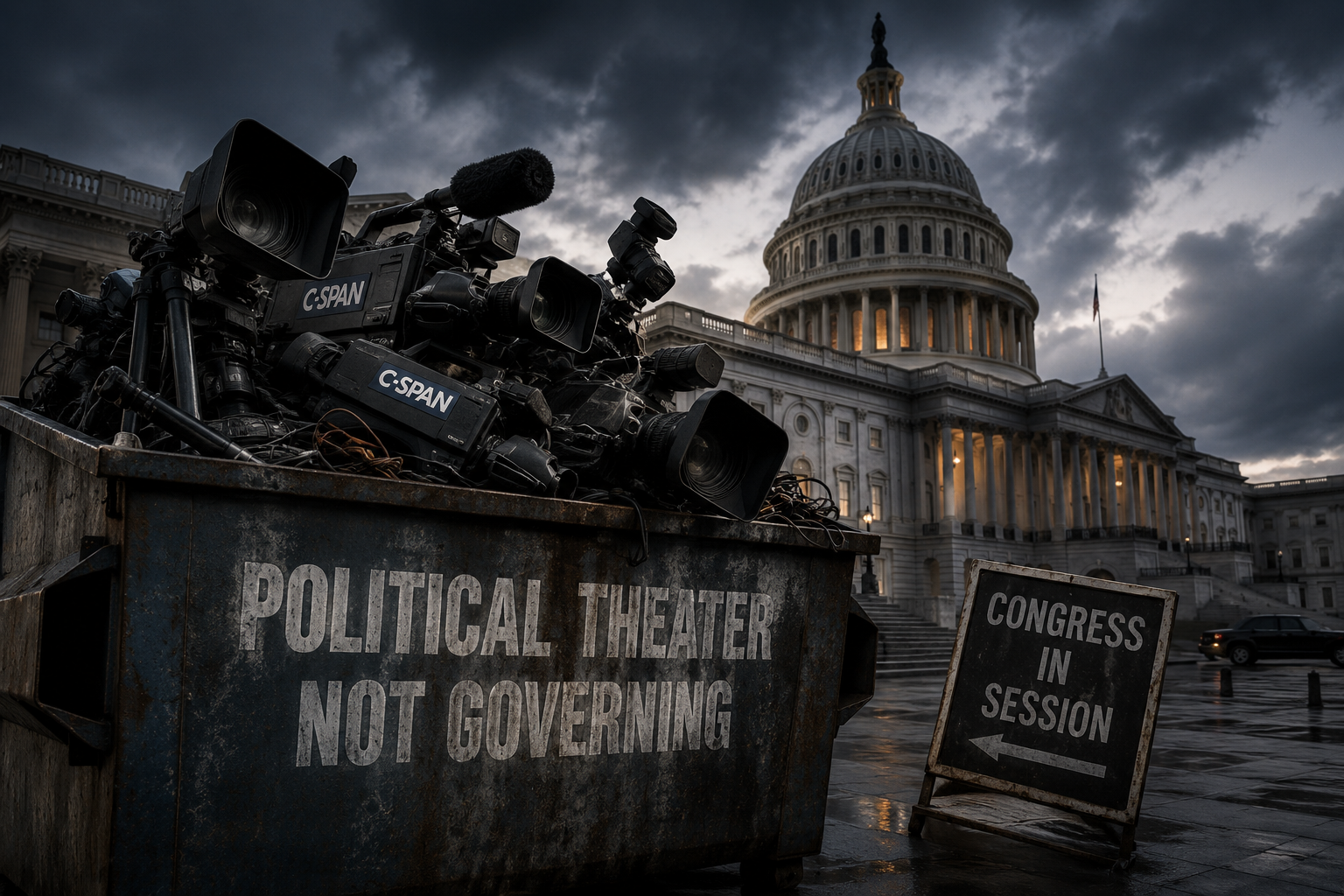
Why cameras, you ask?
Because sometimes solving a big problem starts with fixing a small one.
When the House of Representatives began televising floor proceedings in 1979, many veteran lawmakers warned that Congress would slowly become less about governing and more about performing. Instead of debating colleagues, members would begin speaking to television audiences.
History proved them right.
Democrats like Tip O’Neill (Massachusetts) and Daniel Patrick Moynihan (New York) criticized television cameras for encouraging political theater over thoughtful debate. Several respected Republicans shared those concerns.
Bob Michel (Illinois), the longtime Republican Leader, believed Congress worked best through relationships, quiet negotiation, and bipartisan compromise. He grew increasingly uneasy watching C-SPAN become a platform for partisan messaging, particularly as Newt Gingrich and the Conservative Opportunity Society mastered using television to shape public opinion rather than persuade fellow legislators.
Henry Hyde (Illinois) lamented the decline of collegiality, believing members increasingly tried to impress the media instead of engaging in genuine deliberation. John Rhodes (Arizona) worried televised proceedings were making Congress more partisan. Historians now note that after C-SPAN’s arrival, floor speeches increasingly targeted outside audiences instead of fellow lawmakers.
Daniel Patrick Moynihan’s famous reminder seems especially appropriate today: “Everyone is entitled to his own opinion, but not his own facts.”
The Result
Today, Congress often feels more like a television studio than the world’s greatest deliberative body.
Perhaps that’s one reason why only 10% of Americans approve of Congress, while 86% disapprove—tying the highest disapproval rating Gallup has ever recorded.
When politicians spend more time creating headlines than producing results, public trust inevitably disappears.
Unfortunately, the problem goes far beyond political theater.
Over several decades, Congress has gradually surrendered many of its constitutional responsibilities to the Executive Branch. Constitutional scholars from across the political spectrum increasingly argue that Congress has become less willing to legislate, exercise oversight, reclaim delegated authority, or hold presidents accountable—regardless of party.
Former Congressman Fred Upton summarized the problem bluntly: “I learned ninth-grade civics: You’ve got three equal branches of government. But right now, Congress is not one of them. It abdicated everything to the White House.”
Likewise, the Brennan Center for Justice recently concluded: “An overburdened, underresourced, and gridlocked Congress has contributed to executive abuse, Supreme Court overreach, and public discontent.”
Whether you supported President Biden or President Trump misses the larger point. Every administration naturally expands executive power when Congress fails to do its job. Our constitutional system depends upon three co-equal branches checking one another—not one branch making policy while another holds press conferences.
What Should Change?
Here are a few ideas worth considering:
- Pass every annual budget on time.
- Enact a permanent No Budget, No Pay Act. If Congress cannot perform its most basic constitutional responsibility, members should not be paid.
- Require a balanced operating budget and a long-term debt reduction strategy.
- Enact congressional term limits.
- Naturalization and residency requirements to serve in Congress: a natural-born citizen of the United States and the same residency requirement as the President (14 years).
- Eliminate congressional pensions and rely on retirement plans similar to those available to most Americans.
- Restrict members of Congress to broadly diversified mutual funds while serving and for two years after leaving office.
- Strengthen the War Powers Resolution to reclaim Congress’s constitutional authority over military action.
- Review immigration policy to ensure newcomers embrace America’s constitutional principles and successfully assimilate into our civic culture.
- Modernize the tax code to encourage entrepreneurship while promoting fairness and limiting abusive tax shelters.
- Implement strategies for increasing the birth rates of naturalized citizens.
- Improve transparency on the use of “our” money.
Congress should spend less time campaigning and more time governing.
And finally…
Remove those stupid cameras, roll up your sleeves, and get back to the work the American people elected you to do.
Sources:
- U.S. House of Representatives, Office of the Historian. Television in the House of Representatives (History of televised House proceedings beginning in 1979.). https://history.house.gov/Exhibitions-and-Publications/Electronic-Technology/Television/
- U.S. Senate Historical Office. Live Television Proceedings in the Senate (Senate television coverage beginning in 1986.)
https://www.senate.gov/about/historic-buildings-spaces/chamber/live-television-proceedings.ht - Gallup. Congressional Approval Rating (April 22, 2026). Approval: 10%; Disapproval: 86%.
https://news.gallup.com/poll/708722/disapproval-congress-ties-record-high.aspx - Harvard Kennedy School. Separation of Parties or Powers? Congress Seems Unwilling to Oversee a Rampant Executive (March 2025).
https://www.hks.harvard.edu/faculty-research/policy-topics/democracy-governance/separation-parties-or-powers-congress-seems - The Washington Post. Congress Has Abdicated Power to the Executive Branch (March 10, 2026). Includes former Congressman Fred Upton’s remarks.
- Brennan Center for Justice. Eight Solutions to Unstick Congress (2026).
https://www.brennancenter.org/our-work/policy-solutions/eight-solutions-unstick-congress - Malcolm Gladwell. The Tipping Point: How Little Things Can Make a Big Difference. Little, Brown and Company, 2000.
- U.S. Constitution: Articles I, II. https://constitution.congress.gov/
- War Powers Resolution of 1973 (Public Law 93-148). https://www.congress.gov/bill/93rd-congress/house-joint-resolution/542
- No Budget, No Pay Act of 2013 (Public Law 113-3). https://www.congress.gov/bill/113th-congress/house-bill/325