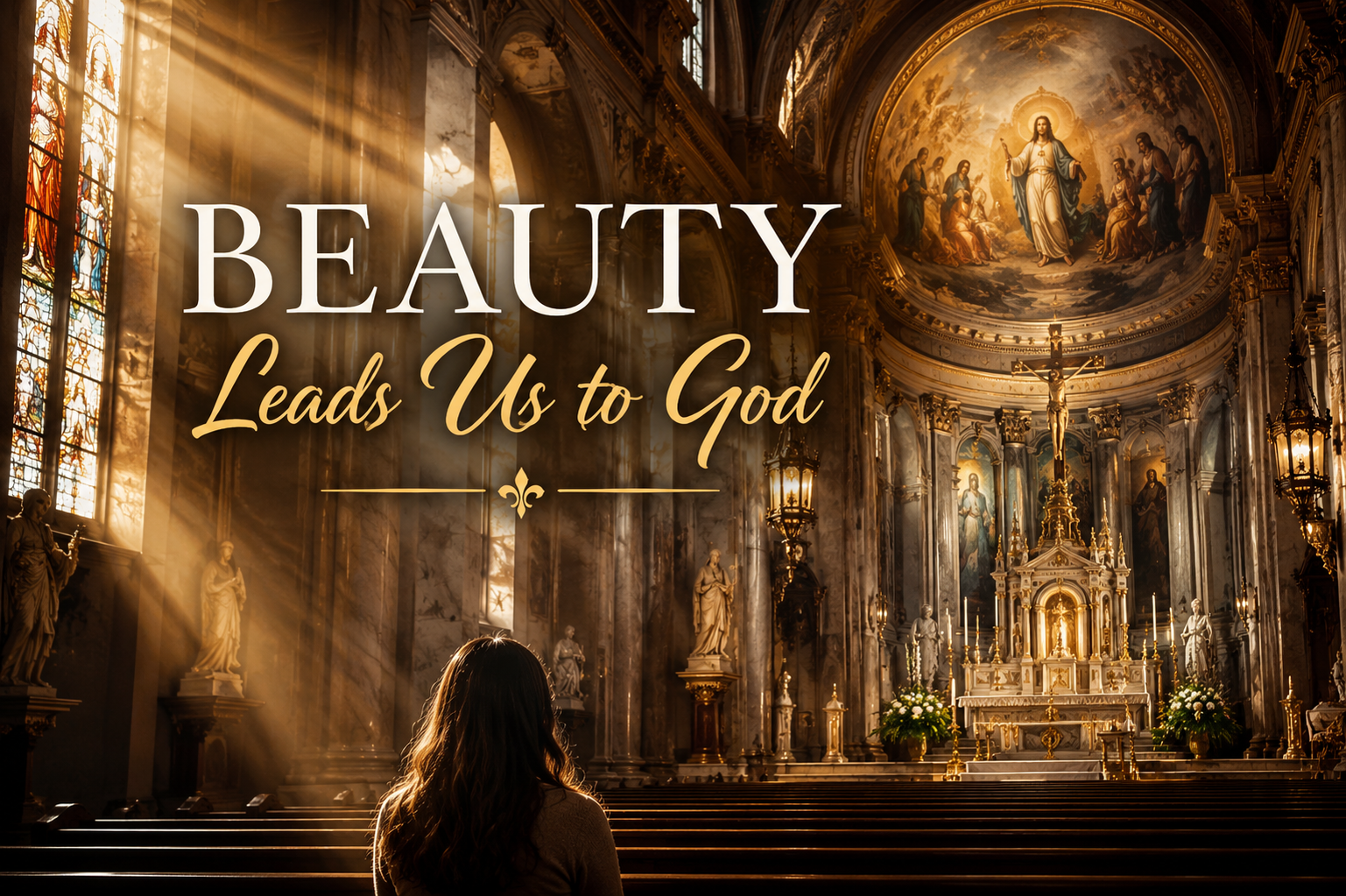
Why Beauty Belongs in the Church
I recently visited the Shrine of Our Lady of Guadalupe in La Crosse, Wisconsin, one of the most important Catholic pilgrimage sites in the United States. Founded by Cardinal Raymond Leo Burke, the shrine was created as a place of prayer, pilgrimage, the sacraments, and devotion to the Blessed Virgin Mary under her title, Our Lady of Guadalupe, Patroness of the Americas.
As I walked through the church, I found myself asking a simple question. Why would the Church invest so much time, talent, and treasure to create a place of such extraordinary beauty?
The answer reaches to the very heart of Catholic theology.
Cardinal Burke envisioned the shrine as a refuge from the distractions of everyday life, a place where pilgrims could encounter Christ through His Mother. He has described it as a place of “truth, goodness, and beauty,” where the faithful can deepen their spiritual lives through prayer, the sacraments, and devotion. Every element of the shrine was intentionally designed to embody the Catholic belief that beauty leads the soul toward God. This vision closely reflects the teachings of Bishop Robert Barron, Pope Benedict XVI, and Saint John Paul II, who remind us that beauty is not merely decorative. It is evangelical.
One of the most common criticisms of the Catholic Church is that it spends too much money on churches, sacred art, statues, stained glass, and sacred music. Critics often argue that those resources should instead be directed entirely toward helping the poor.
At first glance, the criticism seems reasonable. Christians are commanded to care for the poor, feed the hungry, and comfort those in need.
Yet the criticism presents a false choice. For more than two thousand years, the Catholic Church has taught that beauty and charity are not competing priorities. They are complementary expressions of our love for God.
Beauty Reflects the Creator
God created humanity with an innate longing for beauty because He Himself is Beauty. Every sunrise, mountain, ocean, flower, and star filled sky reflects something of its Creator. Created in His image and likeness, we naturally desire to create beauty through art, music, architecture, sculpture, and craftsmanship. Sacred art is not a luxury. It is one of the ways we reflect the Creator whose image we bear.
Human beings are unique among God’s creation. Birds build nests, beavers build dams, and bees build hives because instinct directs them to survive. Only mankind paints cathedral ceilings, composes sacred music, carves marble into saints, and builds magnificent churches simply because God is worthy of our finest gifts. Our desire to create beauty is one of the clearest reflections of the Creator within us. This understanding has been embraced throughout the Church’s history. Bishop Robert Barron has made beauty a central theme of his evangelization. Drawing upon the writings of Hans Urs von Balthasar, Saint Thomas Aquinas, Saint Augustine, Pope Benedict XVI, and Saint John Paul II, he argues that beauty is one of the most effective ways to lead people to Christ.
As Bishop Barron often says, “Beauty is the arrowhead of evangelization.”
Many people who resist Christian doctrine or moral teaching remain open to beauty. A magnificent cathedral, sacred music, inspiring artwork, or a reverent liturgy can awaken something deep within the human heart long before intellectual arguments ever do. Beauty opens the door through which truth and goodness later enter.
Saint Augustine understood this personally. Reflecting on his own conversion, he wrote: “Late have I loved you, O Beauty ever ancient, ever new.” For Augustine, beauty awakened the soul to God’s presence and stirred a longing that ultimately led him to conversion.
Saint Thomas Aquinas taught that beauty possesses integrity, harmony, and radiance because it reflects God’s perfection. Since all authentic beauty comes from God, beautiful churches and sacred art direct our minds beyond themselves to their Creator. Aquinas also taught that religion is the virtue by which we render to God the worship He deserves. Offering God our very best is therefore an act of justice, not extravagance.
The twentieth century theologian Hans Urs von Balthasar brought these ideas together by explaining that beauty can never be separated from truth and goodness. He warned: “Beauty… will not allow herself to be separated and banned from her two sisters without taking them along with herself.” When beauty disappears, truth often becomes difficult to receive, and goodness can be reduced to little more than moral obligation.
Saint John Paul II echoed this understanding in his Letter to Artists: “Beauty is a key to the mystery and a call to transcendence.” He explained that beauty awakens a longing for something beyond ourselves, a longing that ultimately points toward God. Pope Benedict XVI likewise taught that authentic beauty opens the human heart to God and becomes an encounter with the divine. Beauty is not simply decoration. It becomes an invitation to prayer.
This explains why Catholic churches have traditionally been built to inspire awe. Their soaring ceilings, stained glass windows, sacred images, paintings, sculptures, and sacred music are not intended to impress visitors with wealth. They are intended to lift the mind and heart toward heaven. The Mass is a participation in the worship of heaven itself. The surroundings should reflect the extraordinary reality taking place upon the altar.
Sacred art also teaches. Long before widespread literacy, paintings, stained glass, mosaics, and statues became visual catechisms that taught the stories of Sacred Scripture and the lives of the saints. Pope Gregory the Great famously observed that sacred images are “the books of the unlearned.”
The Defense of Sacred Art
The Church’s defense of sacred art rests firmly upon the mystery of the Incarnation. Saint John Damascene, defending sacred images against those who sought to destroy them, wrote: “I do not worship matter. I worship the Creator of matter who became matter for my sake.”
Because God became visible in Jesus Christ, it is fitting that Christ, His Blessed Mother, and the saints be represented in sacred art. Catholics do not worship statues or paintings. They honor the persons represented through them. Sacred images remind us of Christ, the Blessed Mother, and the saints much as family photographs remind us of those we love. Their purpose is always to direct our hearts toward God.
Scripture itself supports offering our very best to God. When King David prepared to offer sacrifice, he declared: “I will not offer burnt offerings to the Lord my God that cost me nothing.” 2 Samuel 24:24
David understood that authentic worship should never be cheap. Love naturally desires to give its very best. Likewise, in the Gospel of John, Mary of Bethany poured perfume worth nearly a year’s wages upon Jesus. When the disciples objected that the perfume should have been sold and the money given to the poor, Jesus defended her act of extravagant devotion. He was not diminishing charity. Throughout His ministry He repeatedly commanded care for the poor. Rather, He affirmed that generous acts of worship directed toward God also have their proper place.
Even the Old Testament reflects God’s desire that worship be beautiful. God instructed Moses to construct the Tabernacle using gold, silver, precious stones, embroidered fabrics, and master craftsmen. Solomon later built the Temple with extraordinary beauty. God did not require these things because He needed them. He desired that His people offer Him their finest work as an expression of reverence and love.
Some Christian traditions have rejected elaborate churches and sacred images, believing simplicity better reflects Christian humility. While those concerns deserve respect, the Catholic tradition has consistently maintained that beauty and charity belong together. The Church has never taught that money should be spent without prudence or that beauty should come before caring for the poor. In fact, Saint Lawrence famously identified the poor as “the treasures of the Church.” Caring for those in need remains a sacred obligation. Yet honoring God with beautiful churches, sacred music, and inspiring works of art does not compete with charity. Both flow from the same love of God.
Perhaps the better question is not whether the Church should invest in beauty, but whether we truly understand why beauty matters.
God created a world overflowing with beauty before He created mankind. Every sunrise, mountain, ocean, forest, and star filled sky reveals something of His glory. Then He created humanity in His own image and likeness, giving us not only the ability to recognize beauty but also the desire to create it. Sacred beauty reflects the Creator whose image we bear.
Beauty is not intended to impress God. It transforms us.
It slows our hurried lives. It lifts our eyes from earthly concerns toward heavenly realities. It awakens wonder, inspires reverence, and prepares our hearts to encounter Christ in the Eucharist. That is why the Church has built beautiful churches for two thousand years.
As Bishop Robert Barron reminds us, beauty is often the first step that leads a searching soul to Christ.
Beauty is not a distraction from worship.
Beauty prepares the soul for worship.
Sources
Sacred Scripture
• Holy Bible, Exodus 25–31 (Construction of the Tabernacle)
• Holy Bible, 1 Kings 5–8 (Construction and Dedication of Solomon’s Temple)
• Holy Bible, 2 Samuel 24:24 (David’s Sacrifice)
• Holy Bible, John 12:1–8 (Mary of Bethany Anoints Jesus)
• Holy Bible, Mark 14:3–9 (The Anointing at Bethany)
• Holy Bible, Matthew 26:6–13 (The Anointing at Bethany)
Church Documents
• Catechism of the Catholic Church, §§2500–2503 (Sacred Art and Beauty)
• Catechism of the Catholic Church, §§1159–1162 (Sacred Images)
• Second Council of Nicaea (A.D. 787), Definition on Sacred Images
• Pope John Paul II, Letter to Artists (1999)
• Pope Benedict XVI, The Spirit of the Liturgy (2000)
• Pope Benedict XVI, Address to Artists, Sistine Chapel (November 21, 2009)
Church Fathers and Saints
• Saint Augustine, Confessions, Book X
• Saint Thomas Aquinas, Summa Theologiae, I, Question 5, Article 4
• Saint Thomas Aquinas, Summa Theologiae, II–II, Question 81 (The Virtue of Religion)
• Saint John Damascene, On the Divine Images
• Pope Gregory the Great, Letter to Bishop Serenus of Marseilles (Epistles, Book IX)
Modern Catholic Theology
• Hans Urs von Balthasar, The Glory of the Lord: A Theological Aesthetics, Vol. I
• Bishop Robert Barron, Catholicism: A Journey to the Heart of the Faith
• Bishop Robert Barron, Word on Fire Ministries, lectures and homilies on Beauty and Evangelization
Shrine Information
• Shrine of Our Lady of Guadalupe, La Crosse, Wisconsin
https://guadalupeshrine.org
Additional Reading
• Joseph Ratzinger (Pope Benedict XVI), Introduction to Christianity
• Joseph Ratzinger (Pope Benedict XVI), The Feast of Faith
• Pope Paul VI, Address to Artists (1964)