Saint Thomas More – When Doing the Right Thing Costs Everything
I believe Saint Thomas More is one of the greatest “modern” saints for business leaders because he lived at the intersection of faith, politics, business, law, family, and executive leadership. Unlike many saints, he was not a monk or missionary. He was a successful professional who faced difficult ethical decisions under intense pressure. His story feels strikingly contemporary.
Although Thomas More lived nearly five centuries ago, few saints feel as relevant today. As a husband, father, lawyer, author, and senior government official, he faced ethical dilemmas, political pressure, and conflicts of conscience that continue to challenge business leaders, public officials, and professionals worldwide.
Most people have only a vague understanding of who Saint Thomas More was. While he is the patron saint of lawyers and politicians, perhaps he should also be known as the patron saint of leaders who refuse to compromise their principles.
Who Was Thomas More?
Thomas More was born in London in 1478. He became one of England’s most respected lawyers, scholars, diplomats, and judges, and later served as Lord Chancellor, the highest-ranking government official after the king.
He also wrote Utopia, published in 1516, which introduced the word “utopia.” The book explored justice, government, greed, and human nature and continues to be studied at universities around the world.
Interesting Facts
He Was a Renaissance Superstar
Thomas More was among Europe’s most educated men. His closest friend was Desiderius Erasmus, one of history’s greatest Christian scholars. Erasmus wrote that no one combined intelligence, humor, kindness, and integrity as More did.
He Was a Family Man
Unlike many renowned saints, Thomas More was not a priest. He was a husband, father of four, lawyer, author, government official, and successful professional.
Remarkably for the early 1500s, he insisted that his daughters receive the same classical education as his son, believing that women should be educated alongside men. His home became one of England’s leading centers of learning.
He Had a Sense of Humor
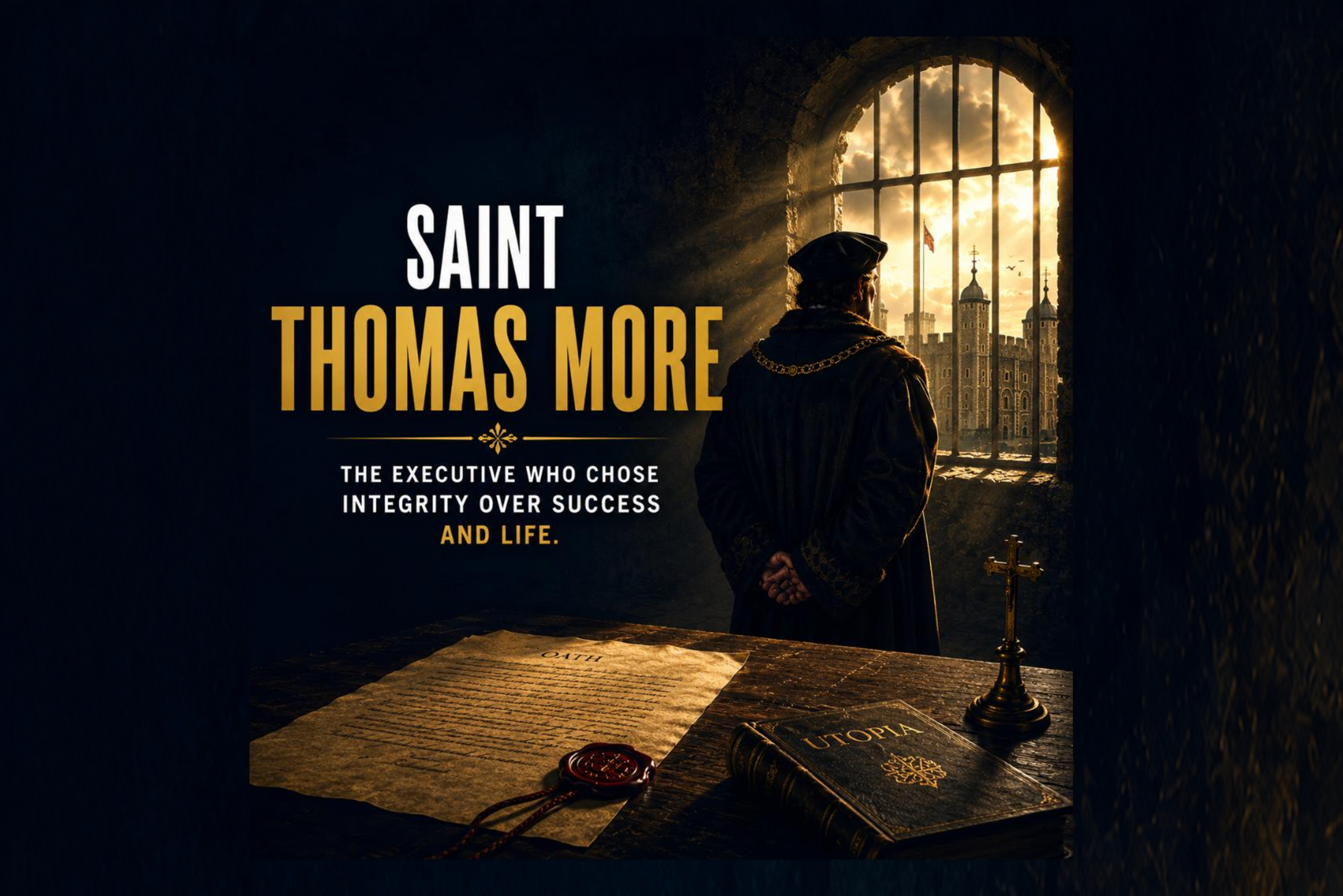
Even while imprisoned in the Tower of London awaiting execution, More never lost his wit. His calm humor in the face of death has become legendary. As he climbed the scaffold, he reportedly told the executioner, “Please help me up. I can manage coming down myself.”
The Decision That Cost Him Everything
When King Henry VIII declared himself head of the Church in England and required public officials to swear an oath recognizing his authority, Thomas More refused.
- He did not organize a rebellion.
- He did not publicly attack the king.
- He simply refused to sign a document he believed was false.
For that decision, he lost his career, his wealth, his freedom, and ultimately his life. His final words became one of history’s greatest statements of integrity: “I die the King’s good servant, but God’s first.”
Why Thomas More Is So Relevant Today
Today’s business leaders often face a different kind of pressure, but the underlying challenge remains the same. The threat is rarely imprisonment. More often, it is the temptation to compromise.
Executives may face pressure to:
- Manipulate financial results
- Overlook ethical concerns
- Ignore emerging risks
- Trade long-term trust for short-term gains
- Remain silent when speaking up could jeopardize their position
Thomas More reminds us that leadership is measured not by the position we hold, but by the principles we refuse to abandon.
Leadership Lessons
- Integrity Is Your Greatest Asset – Reputation takes years to build and only moments to lose.
- Character Is Revealed Under Pressure – Anyone can lead when decisions are easy. Real leadership is revealed when doing the right thing comes at a personal cost.
- Courage Doesn’t Always Look Loud – More never led a protest. He simply refused to violate his conscience. Sometimes quiet conviction is the strongest form of courage.
- Success Without Integrity Is Failure – Thomas More reached one of the highest offices in England. Yet history remembers him not for the office he held, but for the values he refused to surrender.
- Invest in People – Thomas More believed education transforms lives. Great leaders develop people, not just organizations.
Why He Matters Today
Our culture often celebrates influence, wealth, visibility, and success. Thomas More reminds us that none of these achievements matter if they come at the expense of integrity.
Leadership is ultimately about character, not power.
Whether we are business leaders, executives, parents, military officers, or public servants, we will all face moments when doing the right thing carries a personal cost.
Thomas More leaves us with a timeless question: What principle are you unwilling to compromise, even if it costs you everything?