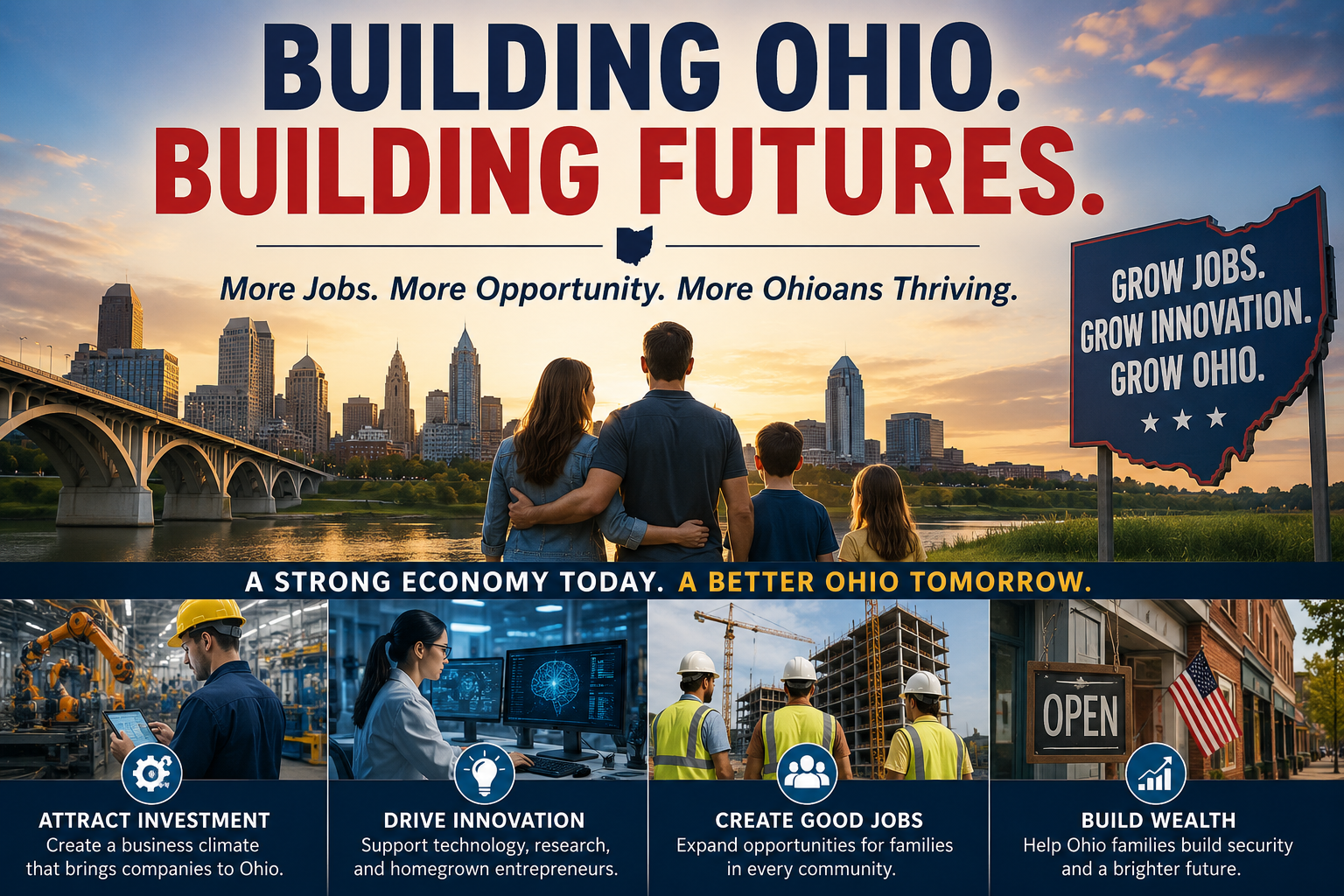
Which approach is more likely to bring investment, innovation, and the jobs of the future to Ohio?
As I continue comparing the candidates for Governor of Ohio, one of the clearest differences I’ve found is how Amy Acton and Vivek Ramaswamy believe economic prosperity should be created.
Both candidates say they want Ohio families to prosper. Both talk about lowering costs and creating opportunity.
But their economic agendas start in very different places.
Amy Acton’s agenda places substantial emphasis on using state policy to reduce the financial pressures facing Ohio families. Her proposals include targeted tax relief, healthcare initiatives, education, consumer protections and other government actions intended to lower household costs. Her campaign describes lowering costs for working families as her top priority.
Acton also has proposals aimed directly at growing jobs and businesses in Ohio, so it would be unfair to suggest that she ignores private-sector growth.
But when I look at the overall emphasis of her economic agenda, I see government playing a much larger role in improving economic conditions through programs, tax credits, public investment, regulation, and targeted assistance.
That concerns me for two reasons.
Government Programs Have to Be Paid For
The first is simple.
Government programs aren’t free.
Government can create a tax credit, subsidize a service, expand a program or provide financial assistance. But ultimately those commitments must be financed through existing revenues, new revenues, reduced spending elsewhere, federal funding or some other source.
This isn’t merely a theoretical concern about Acton’s proposals.
When Acton released her affordability agenda in April, the independent Statehouse News Bureau reported that the plan contained numerous ideas but relatively few specifics about how some of them would be funded. Among the proposals were child tax credits of $500 to $1,000 and a refundable tax credit for lower-income families.
That doesn’t mean the proposals cannot be funded.
But voters deserve to know what they cost and where the money comes from.
Good intentions aren’t a funding mechanism.
But My Bigger Concern Is Economic Growth
My larger concern with Acton’s approach isn’t simply the cost of government programs.
It’s that I believe Ohio’s fundamental economic challenge lies somewhere else.
You can help a young family with childcare.
You can make healthcare more affordable.
You can provide a tax credit.
You can prepare a young person for a career.
But after we’ve done all of that, there is still a fundamental question:
Where is that young person going to work?
Ohio needs more than programs that make it easier to live here.
We need businesses that make people want to build their lives here.
We need entrepreneurs.
We need investment.
We need existing Ohio companies expanding.
And we need companies developing the technologies of the future to look at Ohio and decide: “That’s where we want to build.”
Ramaswamy Starts From a Different Place
Ramaswamy’s economic agenda starts much closer to that question.
His campaign proposes phasing out Ohio’s state income tax, beginning with capital-gains taxation; reducing property taxes; cutting government spending and regulatory barriers; expanding energy supplies; and attracting future industries with dependable, lower-cost energy.
His campaign explicitly describes its objective as creating an economy that rewards “work, investment, and innovation” and says it wants to attract industries of the future.
The economic theory is straightforward:
Make Ohio attractive to investment
↓
Businesses start, relocate and expand
↓
Capital flows into Ohio
↓
Jobs are created
↓
Employers compete for workers
↓
Wages and opportunities grow
↓
Young families stay and move here
↓
Communities and the tax base grow
That’s the philosophy I find more compelling.
Ohio Should Compete for Innovation
This is especially important because the economy is changing rapidly.
Artificial intelligence.
Biotechnology.
Advanced manufacturing.
Semiconductors.
Robotics.
Aerospace and defense.
Energy technology.
Data infrastructure.
And industries that don’t even exist yet.
Ohio is competing for that investment.
Companies can build somewhere else.
Investors can put their capital somewhere else.
Entrepreneurs can start companies somewhere else.
And talented young Ohioans can take their skills somewhere else.
That’s why I believe Ohio’s economic-development strategy should begin with a simple question: What would make the world’s most innovative companies and entrepreneurs choose Ohio?
Taxes matter.
Regulation matters.
Energy costs matter.
Infrastructure matters.
Universities matter.
Workforce quality matters.
Quality of life matters.
Government should be relentlessly focused on making Ohio competitive in all of them.
Government Has an Important Role
That doesn’t mean government has no role.
Quite the opposite.
Businesses need good infrastructure.
They need an educated workforce.
They need safe communities.
They need reliable energy.
They need functioning courts.
Workers need good schools and communities in which they want to raise their families.
Some of Acton’s priorities therefore address legitimate components of a competitive economy.
But I see an important distinction between government creating the conditions for prosperity and government attempting to produce prosperity primarily through government action.
I favor the former.
Businesses Create Opportunities for Families
Attracting businesses isn’t about choosing corporations over working families.
Businesses employ working families.
When a biotechnology company, semiconductor manufacturer, AI company or advanced manufacturer invests in Ohio, it doesn’t only benefit its shareholders.
It needs engineers.
Technicians.
Scientists.
Construction workers.
Electricians.
Programmers.
Accountants.
Managers.
Manufacturing workers.
Truck drivers.
Suppliers.
Those employees buy houses, spend money in their communities, pay taxes and raise families.
New economic activity creates still more economic activity.
That’s why I believe a growing private-sector economy is the foundation on which sustainable prosperity is built.
Government cannot redistribute prosperity that the economy has not first created.
Ramaswamy’s Numbers Still Have to Work
Supporting a more private-sector-oriented strategy doesn’t mean accepting every proposal without scrutiny.
Ramaswamy proposes eventually making Ohio an income-tax-free state over approximately ten years, beginning with capital-gains taxation.
That’s ambitious.
And reducing taxes reduces government revenue before any hoped-for economic growth necessarily arrives.
So his plan has to answer an important question too: How do the spending reductions and economic growth keep pace with the lost revenue while maintaining essential state services?
His campaign says it would cut government “bloat” and regulatory costs.
But slogans about waste aren’t enough either.
The numbers have to work.
That’s the same standard I believe should apply to both candidates:
What will you do? What will it cost? How will you pay for it? And what measurable economic result should Ohioans expect?
Two Different Visions
The distinction I see is ultimately this:bActon’s center of gravity is using government policy to reduce costs, support families and strengthen communities, with the expectation that those investments will contribute to a stronger economy.
Ramaswamy’s center of gravity is reducing taxes, regulation, energy costs and government spending to encourage private investment, entrepreneurship and business growth.
Those are not absolute descriptions. Acton talks about businesses, and Ramaswamy talks about families, education and affordability. Their actual platforms contain elements of both approaches.
But they reveal very different economic instincts.
And when I consider what Ohio needs most for the next generation, I believe the priority should be attracting investment, innovation and the businesses that will create tomorrow’s jobs.
This Is About Our Children
Ultimately, that’s why this matters to me.
I don’t want our children and grandchildren to graduate and discover that the most exciting opportunities are somewhere else.
I want the biotechnology company here.
I want the AI startup here.
I want the semiconductor investment here.
I want advanced manufacturing here.
I want entrepreneurs building companies here.
And I want existing Ohio businesses growing here.
I want an Ohio graduate to be able to say:
Companies are competing to hire me.
Entrepreneurs are building here.
Investment is coming here.
I can build my career and raise my family here.
I don’t have to leave Ohio to find my future.
That’s why, when I compare these two economic philosophies, I favor the approach centered on making Ohio a destination for private investment, innovation, entrepreneurship and job creation. That’s why in my opinion, Vivek is the better choice to help build Ohio’s future.
Bring investment to Ohio.
Grow businesses.
Create jobs.
Let Ohioans build wealth.
We shouldn’t have to convince our children to stay in Ohio. We should build an economy that makes them want to stay.
Vote for policy, experience and results—not personality.
Sources
Amy Acton — Affordability Agenda
Amy Acton — Issues and Priorities
Statehouse News Bureau — Acton proposals and funding details
Vivek Ramaswamy — Ohio Economic Plan
Vivek Ramaswamy — Tax and Energy FAQ