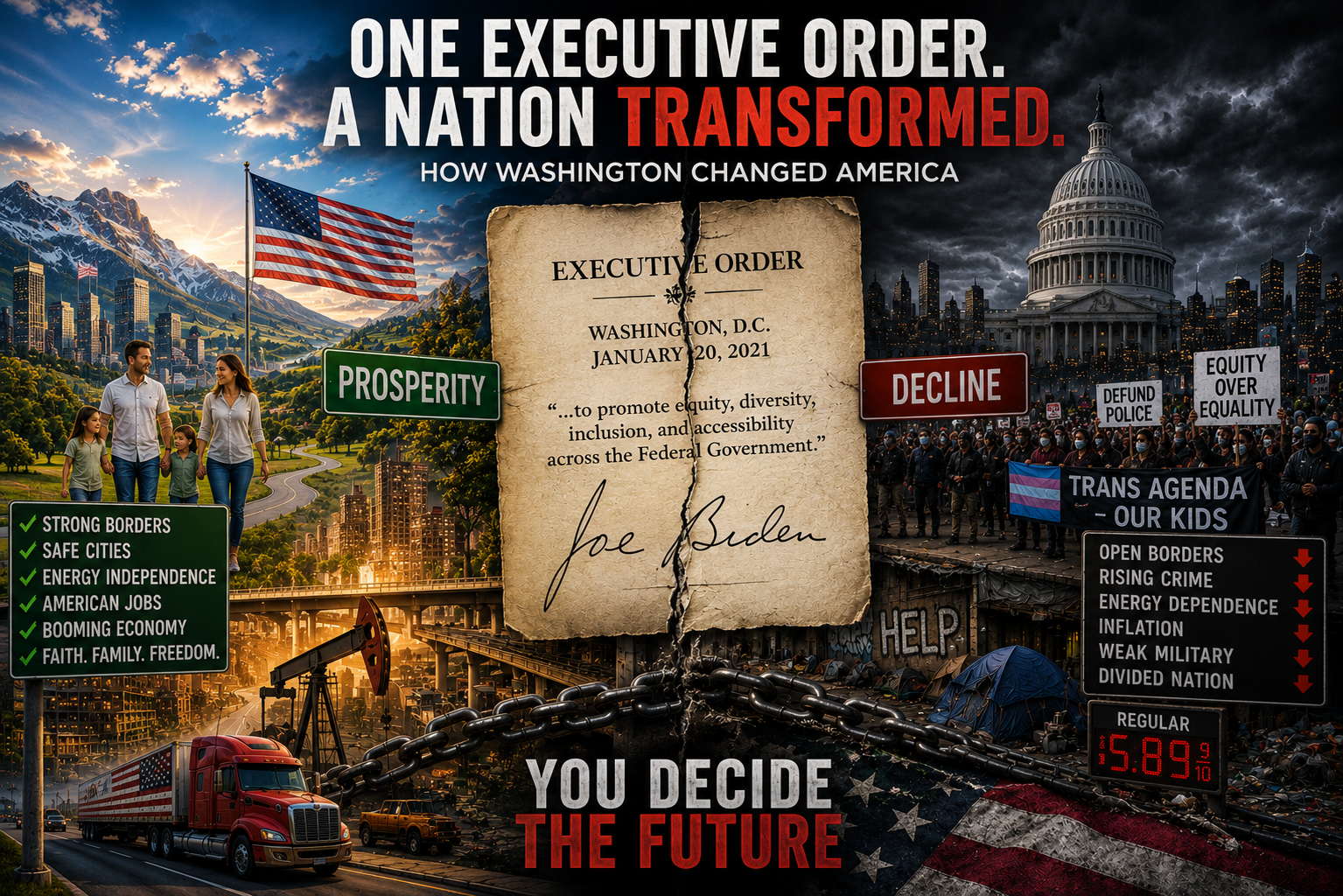
Executive Order 13985, titled Advancing Racial Equity and Support for Underserved Communities Through the Federal Government, was signed by Joe Biden on January 20, 2021 — his first day in office.
Do you really trust the federal government to choose outcomes?
This means that Washington (i.e., the federal government) plays an increasing role in determining how benefits, opportunities, and resources are distributed based on evolving equity frameworks.
Executive Order 13985 directed federal agencies to review policies and programs for what the administration described as “systemic barriers” affecting underserved groups. It launched a “whole-of-government equity agenda” focused on areas such as:
• Federal Grants and Contracting
• Housing
• Healthcare Access
• Education
• Data Collection
• Hiring and Workforce Practices
Total U.S. federal spending in 2021 was estimated at around $7 trillion ($1.6 trillion in discretionary spending). The amount of money involved is difficult to comprehend, and so is the level of influence tied to federal programs and incentives. A major portion of society quickly moved behind the fiscal wake of these new federal directives and corresponding programs. Businesses often pivot to align with new administrations in Washington and work aggressively to remain within the government’s good graces. For example, if the federal government promotes the normalization of social issues tied to equity and LGBTQIA+ initiatives, many corporations are eager to join the movement.
“When all government, in little as in great things, shall be drawn to Washington as the center of all power, it will render powerless the checks provided.” — Thomas Jefferson
The Biden administration argued the order was necessary to address longstanding inequities and improve access to opportunity. Federal agencies were instructed to develop “Equity Action Plans” and embed equity considerations into policy decisions. Supporters viewed EO 13985 as an attempt to address systemic disadvantages and expand opportunities for historically underserved communities.
Critics, however, raised concerns that “equity” programs can move beyond equal opportunity toward preferential treatment or outcome-based frameworks tied to race, identity, or group status. Equal opportunity means everyone gets a fair chance. It does not mean everyone gets the same result.
Concerns included:
• Expansion of DEI bureaucracies
• Race-conscious hiring and contracting
• Politicization of institutions
• Ideological conformity
• Tensions between equality of opportunity and equality of outcomes
Robert Barron became one of several Christian voices expressing caution about modern DEI and equity frameworks. Barron argued that concepts like diversity, equity, and inclusion can be valuable when grounded in authentic justice and love, but dangerous when elevated into ideological absolutes detached from truth, merit, human dignity, or moral order.
“The worst form of inequality is to try to make unequal things equal.” — Aristotle
Barron’s broader concern was that some equity-based initiatives redefine justice primarily through power dynamics and group identity rather than individual dignity, equality before the law, and objective moral truth.
Do you really want the government choosing winners and losers?
EO 13985 was rescinded in January 2025 by the Trump administration as part of a broader rollback of federal DEI initiatives.
Primary Sources
• Congressional Budget Office – The Federal Budget in Fiscal Year 2025
• Congressional Budget Office – Discretionary Spending in Fiscal Year 2025
• Peter G. Peterson Foundation Budget Chart Pack