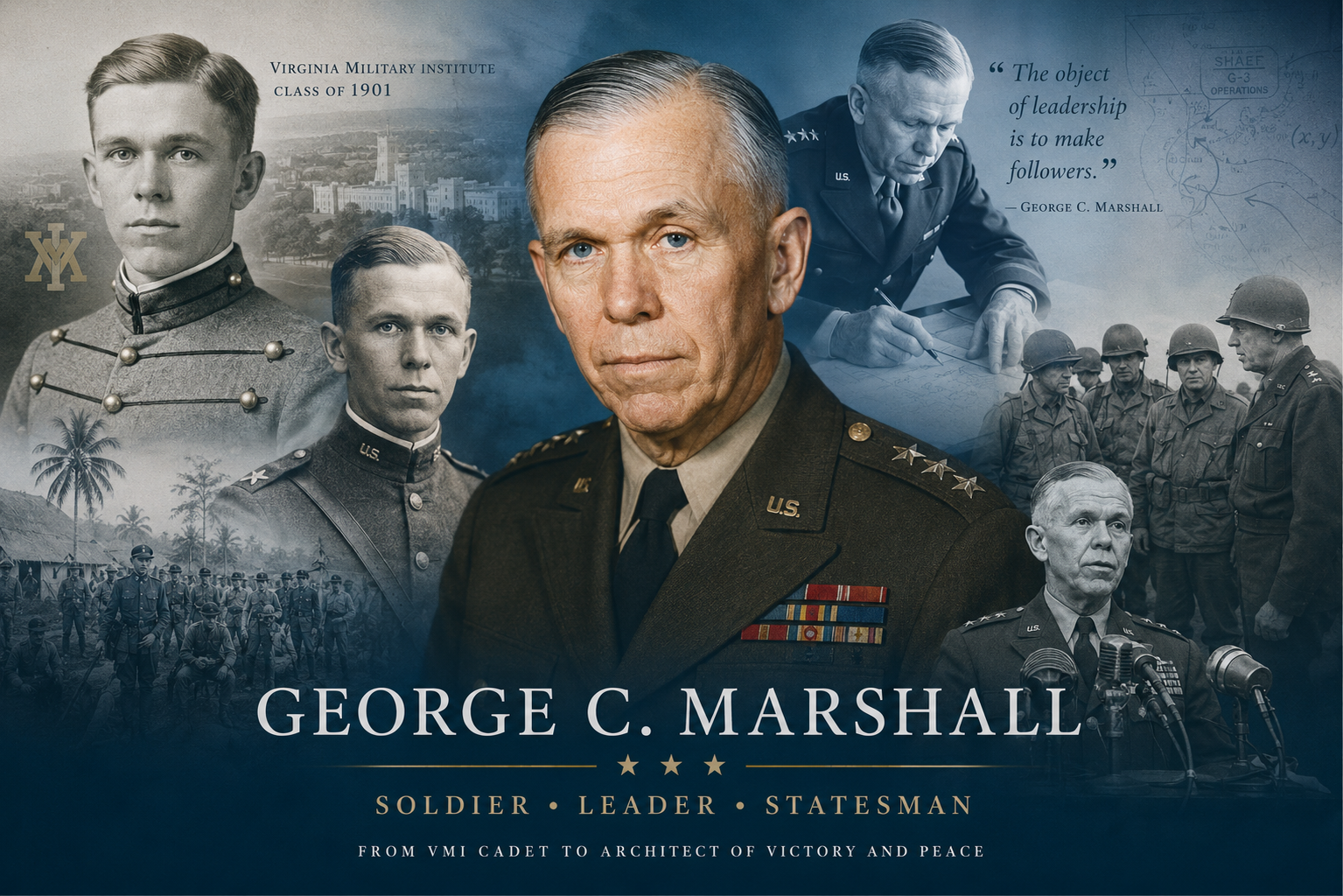
George Catlett Marshall Jr was one of the most impactful American leaders of the twentieth century.
Every May 15, starting in 1951, Virginia Military Institute honors General George C. Marshall during “Marshall Day.”
Marshall graduated from VMI (founded in 1839) in 1901 and joined an honored list of military leaders associated with the institute, including Jonathan M. Wainwright, Lewis B. Puller (“Chesty” Puller), George Patton, John S. Mosby (“Gray Ghost”), and Stonewall Jackson.
After graduation, Marshall rose through the ranks of the U.S. Army and became the architect of America’s military expansion during World War II.
President Franklin D. Roosevelt reportedly said: “I could not sleep at ease if you were out of Washington.”
President Harry S. Truman called him: “The greatest living American.”
And British Prime Minister Winston Churchill referred to Marshall as: “The organizer of victory.” Referring to WII
As Army Chief of Staff, Marshall helped transform the U.S. military from a relatively small force into one capable of defeating Nazi Germany and Imperial Japan alongside the Allies.
But Marshall’s leadership extended far beyond war.
After World War II, he served as Secretary of State and launched what became known as the Marshall Plan — a massive effort to rebuild war-torn Europe, restore stability, reduce suffering, and prevent future conflict. The plan helped revive economies, strengthen democratic allies, and counter the spread of Soviet communism.
For that work, Marshall received the Nobel Peace Prize in 1953.
What made Marshall extraordinary was not ego or self-promotion. He was known for humility, discipline, integrity, calm leadership under pressure, and putting mission above personal ambition.
In a culture obsessed with celebrity and self-promotion, George Marshall reminds us that some of history’s most important leaders were defined by competence, character, and quiet service.
Marshall’s rise is compelling because he was not:
• Flashy
• Politically connected
• Charismatic in the modern sense
He became extraordinary through:
• Calmness under pressure
• Emotional restraint
• Compassion without dramatics
• Deep loyalty
His book, The Armed Forces Officer, published in 1950, remains a classic for leaders. The book became one of the most respected guides to military leadership, emphasizing:
• Character
• Duty
• Servant leadership
• Discipline
• Moral courage
• Professionalism
• Responsibility to subordinates
Many historians view him as a model of servant leadership, integrity, humility, and strategic vision. A role model like the Saints is one we desperately need today.
Free downloadable PDF version: The Armed Forces Officer PDF